





On September 18, 2008, the SEC announced an emergency ban on short-selling. 797 tickers belonging to companies in the financial industry could not be shorted for the next three weeks. This was a drastic if temporary move, cutting off short activity cold-turkey to save the patient. Or, so it seemed at the time.
The rule went into effect the next day. Companies were added and dropped, exceptions were made — and then, exceptions to those exceptions — but the overall impression left with the investing public was one of a total ban, a wall of protection around the banned stocks.
SEC Chairman Cox commented recently that, “the actual effects of this temporary action will not be fully understood for many more months, if not years”. We here at Deep Capture just could not wait that long. So we looked at actual short sales effected on NYSE ARCA for the tickers in question, for the duration of the ban. The picture that emerged was less that of a total ban and more of a… well, let’s allow the numbers to speak for themselves.
We chose NYSE ARCA (Archipelago) for this experiment because it makes short sale data available. While it would be easy for all exchanges to release data on short sales, only two do so. This practice started as part of a pilot program to measure the effects of REG SHO and at one time, every exchange participated. By August 2007, the SEC had stopped requiring the release of short sale data because it was too burdensome for the exchanges. The two that went on publishing (Archipelago and Philadelphia), we might assume, forgot to turn off the database scripts that automatically generate these reports.
So what does the data say? To keep things simple at the outset, we only considered the original 797 tickers on the ban list. There were 940,000,000 shares worth of short sales executed on Archipelago for that subset of banned tickers. These 797 tickers were 80% of the 976 that eventually ended up on the list. Furthermore, only 705 (under 90%) had short trades executed on Archipelago. And for those tickers, Archipelago executed only 19% of the overall volume during the dates in question. Thus, to back into an estimate of the total shorting that took place in these tickers while there existed a ban against shorting them, one would calculate that 940,000,000 is 19% of 90% of 80% of all the shorting: this would imply that over 7 billion shares were shorted in these companies, while they enjoyed a ban against shorting their stock.
To be fair, a few tickers ended up being dropped from the list (and could be expected to exhibit regular shorting activity for part of the ban period). Excluding all trades in those tickers during the ban period (a generous assumption) would mean subtracting 1.4 million in volume. 938 million and change is the most conservative number that results from this calculation.
One question that naturally arises is this: what level of short sale activity should be considered normal on Archipelago? During the same period a year ago (a period that included the same number of trading days), these very same stocks racked up 332 million in total short volume on Archipelago. Granted, Sep/Oct 2008 was no ordinary time for market volume. Yet an almost threefold increase over the same period last year, coming at a time when there was ostensibly a total ban on shorting these stocks strains credulity. Below is a chart comparing the short sale volume for the same dates in 2007 and 2008:
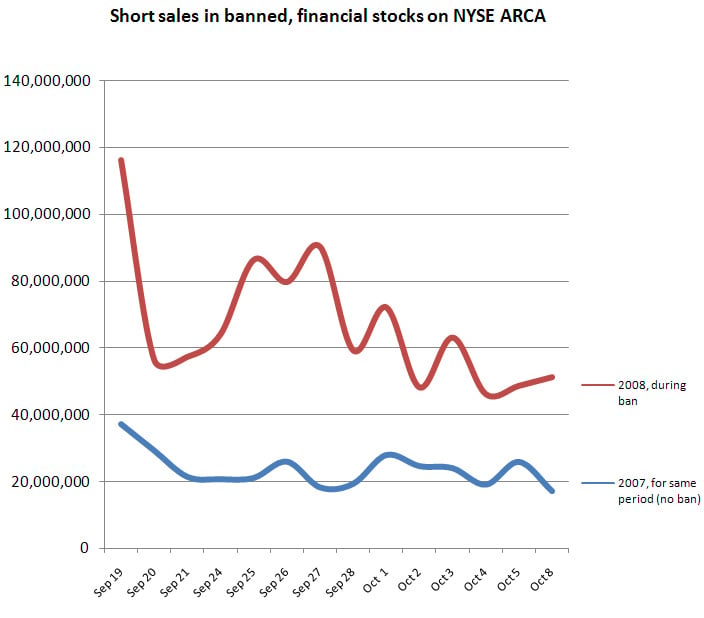
Coverage of the ban in financial media has been almost uniform in emphasizing the ineffectiveness of the ban. Jubin Zelveh titles his Portfolio.com blog entry on Dec. 19, “S.E.C. Short-Sale Ban: Pretty Much Useless” and quotes from a new academic paper in the pipeline showing a steep drop in the prices of banned NYSE-listed stocks. William Ackman of Pershing Capital (a person-of-interest here at Deep Capture), quoted in a Reuters piece on Oct. 6, proclaims, “Short sellers have been blamed for bringing down the market, but since the ban, the markets have been falling even further, which means ‘the longs’ are selling now.” Menachem Brenner and Marti G. Subrahmanyam, in their commentary on Forbes.com from October 1st titled, “End The Ban On Short-Selling” speculate that the ban on short sales, “may have already contributed to a further decline in prices”.
The take-away from the coverage is that there was ostensibly a total ban on short selling and prices declined anyway – suggesting that short sales were not to blame for falling prices, after all. A stretch, even if one concedes the underlying assumption but a somewhat plausible argument. What it fails to consider is how imperfect a ban this turned out to be.
And finally, Chairman Cox himself declared just the other day, “The costs appear to outweigh the benefits” — professing regret over the short-selling ban. What costs/benefits went into that analysis, we do not yet know. What we do know is that the ban on short selling was far from total in practice. A barrier marked with 940 million holes is, in fact, a sieve… and any analysis that laments its meager virtues should recognize that fact.
This series will analyze the many ways in which the short-sale ban has indeed been a sieve.
If this article concerns you, and you wish to help, then:
1) email it to a dozen friends;
2) go here for additional suggestions: “So You Say You Want a Revolution?“





Dr. DeCosta, I have two questions.
1. Because of novation, wouldn’t the NSCC be the one that is obligated to deliver fails, even if the shares are not delivered to them?
It seems there are two independent contracts. I don’t care if the seller doesn’t deliver shares to the NSCC. All I care about is that the NSCC owes me shares and is contractually obligated to deliver them.
Can’t someone sue the NSCC as they are the only party (except for x-clearing) that owes participants shares?
2. How come fails to receive and fails to deliver are different dollar amounts? Should every “receive” be matched with a “deliver”?
Something funny going on here.
How come the fails to deliver and fails to receive as published in the DTCC annual report don’t match the industry numbers?
In both cases, why don’t receives and delivers match?
Is it because of different “mark to market rules”? If so, does the difference show how much the stocks have been driven down on average?
Evren,
During a total ban, like a total block out of the sun, there were 3x as many short sales executed during the period as there had been during the same non-block out period the previous year. It is a mystery. How would one accomplish that? The brokers would never accept a short sale during that time unless they were all marked as long sales.. a glitch, and these were recorded just on ARCA. Perhaps ARCA hadn’t heard of the ban. Surely, this couldn’t have been representative of all the exchanges.. that’s the ticket.. just ARCA.. glitched. And they continued to glitch during the entire period and nobody was watching from within the SRO’s or from FINRA or the SEC.
It is indeed a puzzlement.
Your article has been sent to enforcement as well as the OIG. Surely there will be an adequate explanation of this mystery.. or not.
The Thugs still live, Buyin’s are met with sellers who are filling their own buyin’s with new sales. MUST be stopped, I watched it all day in STSI yesterday, stock on SHO list. Buyins started Monday stock was offered at $3.80 offer was at least 300K buys came form everwhere and all amts. Its was a complete rolling of a position to get more days of being Naked short. Today stock off Reg SHO list. I’am glad I dont own any and today was fun to watch them attack the stock and knock it down on a big news day and up market. This is straight from Naked Shorting 101 hand book.
you mean the SEC passed a rule and it wasn’t strictly enforced?
nawwwwwwwwwwwww…………..
Evren:
Regarding your person of interest, William Ackman:
Pershing was once a subsidiary of Donaldson, Lufkin, & Jenrette – ya know, the same Donaldson that didn’t enforce settlement when he was chairman at the SEC?
http://www.pershing.com/media/sofc-063008.pdf
At June 30, 2008, amounts receivable from and payable to brokers, dealers and clearing
organizations include ($ in millions):
Receivables:
Securities failed to deliver $ 885
Clearing organizations 153
Broker and dealers 812
Total receivables $ 1,850
Payables:
Securities failed to receive $ 1,024
Broker and dealers 1,696
Total payables $ 2,720
At June 30, 2008, the market value of securities that the Company has pledged to
counterparties and clearing organizations was $2.1 billion, which is related to collateralized
financing and custody agreements. At June 30, 2008, the market value of securities received
as collateral from counterparties was $2.5 billion. The Company routinely re-pledges, lends
or resells these securities to third parties. At June 30, 2008, the market value of collateral repledged
or lent was $374 million.
The Company had financial instruments owned and financial instruments sold, but not yet
purchased recorded at fair value on the statement of financial condition as follows ($ in
millions):
Financial Instruments Sold, But Not Yet Purchased
Equities $ 20
Corporate debt 72
U.S. Government debt 5
Municipal debt –
Other 3
$ 100
anonymous,
SEC’s (and everyone else’s) figleaf of a cover in all this are the “exceptions to the rule”. But the fact remains that all those exceptions were part of day-to-day business the year before and contributed to the baseline totals. They were not, one may surmise, the bulk of activity. So, how is it that a minority adds up to a multiple of the previous total, even with increased activity?
Will their crookedness ever end?
fwiw.. FFGO PR..
http://www2.barchart.com/news.asp?sym=FFGO
6-Jan-2009
Other Events
ITEM 8.01 OTHER EVENTS
The Company confirms that it has transferred an amount of 67,741,815 shares of Hunt Gold Corporation Common Stock (HGLC.PK) and not the previously stated amount of 40,059,532 shares of Hunt Gold Corporation Common Stock (HGLC.PK) to ensure the final Stock distribution. This was effected on December 22, 2008.
The Company and its Transfer Agent had calculated that the number of Hunt Gold Corporation Common Stock due to these holders in “Street Names” was in the amount of 27,681,135 shares of Hunt Gold Common Stock (HGLC.PK). These shares were placed in a “Reserve Account” at the Transfer Agent to Hunt Gold Corporation (HGLC.PK).
The DTCC has advised the Company that they calculated that an additional amount of 67,740,667 shares of Hunt Gold Corporation Common Stock (HGLC.PK) were required to complete the payment of this Stock Dividend by Fortress Financial Group, Inc. The Company undertook to; and has transferred the difference; that being in the amount of 67,741,815 shares of Hunt Gold Corporation Common Stock (HGLC.PK) to the “Reserve Account” held at the Transfer Agent to Hunt Gold Corporation (HGLC.PK).
Fortress Financial Group, Inc. effected this transfer of Hunt Gold Corporation shares of Common Stock (HGLC.PK) to ensure that all its eligible stockholders receive their shares in Hunt Gold Corporation (HGLC.PK) and to prevent any further delays in the payment of these Stock Dividend shares of Hunt Gold Corporation Common Stock.
The Transfer Agent to Hunt Gold Corporation (HGLC.PK) has confirmed that these shares of Hunt Gold Corporation Common Stock (HGLC.PK) were sent to the DTCC for distribution.
Neither the Company, nor Hunt Gold Corporation (HGLC.PK) or its Transfer Agent are responsible for the payment of these remaining dividends in Hunt Gold Corporation as this distribution to stockholders is being effected by the DTCC.
The Company has now completed the Stock Distribution in respect of the Hunt Gold Corporation (HGLC.PK) Stock Dividend.
——————————————————————————–
In addition to aiding and abetting these criminals the SEC also does not want to repay our losses due us!!
GAO report says SEC failing to close cases, distribute funds to harmed investors
WASHINGTON (Thomson Financial) – The Securities and Exchange Commission has failed to distribute about 80 pct of the funds set up in a 2002 program aimed at compensating investors injured due to violations of US securities laws, the Government Accountability Office said in a report released today.
GAO also said the SEC has harmed targets of securities fraud investigations by officially keeping investigations open long after the SEC has stopped investigating.
‘We heard an allegation last year that many of the cases that the SEC tells Congress it’s pursuing are really just at a standstill, waiting to be closed, and this report confirms it,’ said Senator Charles Grassley, the Iowa Republican who requested the report.
‘That’s not fair to those under investigation and it misleads the public by implying that the SEC is more active than it really is,’ he added.
The GAO report said the SEC’s failure to distribute funds to harmed investors may be related to the fact that many cases remain open even though all activity has ceased.
Specifically, GAO said that only 1.8 bln usd has been distributed to investors out of the total 8.4 bln usd that has been awarded since 2002. The report said SEC officials cite problems identifying harmed investors and other barriers to distributing money and closing the cases.
However, the GAO report said the ‘decentralized approach’ to managing the program at the SEC may also be to blame. It added that keeping the cases officially open for longer than needed is unfair to targets of these cases.
The report said that as of March 2007, 300 of the cases open in one regional office were more than two years old or were no longer being pursued.
As a result of these findings, GAO said the SEC needs to develop new procedures for closing these investigations, as well as written policies and criteria for approving new investigations. GAO also said the SEC should create a ‘comprehensive plan’ to clarify how money is distributed to harmed investors.
http://www.forbes.com/markets/feeds/afx/…
~~~~~~~~~~~~~~~~~~~~~~~~~~~~~~~~~~~~~~~~~~~~~~~~~~~~~~~~~~~~~~~~~
OH MY!!! Is the noose closing around the necks of those who file bogus complaints to the SEC?
Sean,
That is a half truth story. The true criminals such as certain hedge funds and journalist seem to get a bill of good health and the good word from the SEC there was no wrong doing on their part miraculously fairly quickly while the cleared companies sit on the under investigation/open SEC list indefinitely. Look what happened to Overstock !
Noose is definitely getting tighter around those necks. I’ll bet if an investigation into the SEC and the chronic complaint senders to the SEC would reveal all those criminal shorties and their true relationship with SEC investigators. Of course, unless there are more Gary Aquirre’s, that point will never be established.
Reporter101
time, time, time- it’s taking too long to move against these scumbags….We don’t even have a complaint filed against a manipulative short sellers in the BSC, LEH, FNM etc….debacles…how hard is it to follow SELL tickets?
They must know who is doing the selling and they CHOOSE to look the other way…
Why……
The noose is tighening more and more everyday!!!
Mr. SPECTER. Mr. President, the Finance Committee, under the chairmanship of Senator Grassley in the 109th Congress, and the Judiciary Committee, under my chairmanship in the 109th Congress, conducted an extensive inquiry into allegations of insider trading. The issue is succinctly framed in a letter which I wrote to Christopher Cox, Chairman of the Securities and Exchange Commission, in a letter dated December 24, 2008. I ask unanimous consent that the full text of this letter be printed in the Record at the conclusion of my statement.
The PRESIDING OFFICER. Without objection, it is so ordered.
(See Exhibit 1.)
Mr. SPECTER. The matter could be most succinctly articulated by quoting from parts of this letter as follows:
Dear Chairman Cox:
Senator Charles Grassley and I have already issued public findings concerning the Securities and Exchange Commission’s ….. investigation into Pequot Capital Management’s ….. suspicious trading.
Referring to insider trading.
These findings also criticized the original Office of Inspector General’s report, which essentially ignored former SEC investigator Gary Aguirre’s complaints of political influence in the Pequot investigation ….. after the new SEC Inspector General, David Kotz, largely agreed with our findings and recommended disciplinary action against Mr. Aguirre’s supervisors up to the Director of Enforcement, the SEC selected an initiating official who, in a matter of days, found that disciplinary action was unwarranted. That official was described in press accounts as an Administrative Law Judge, and it was not until further inquiry that the SEC admitted she was not acting in a judicial capacity in issuing her decision. I am now writing because recent events provide the SEC with an opportunity to make good on its Pequot investigation, despite having ….. closed the case in November 2006.
….. The investigation centered, in part, on evidence that David Zilkha, a Microsoft employee who joined Pequot in April 2001 and separated from Pequot in November 2001, may have given Arthur Samberg, Pequot’s CEO, inside information regarding Microsoft.
Documents recently filed in a Connecticut divorce case (Zilkha v. Zilkha) disclose that Pequot has made or promised to make payments of $2.1 million to Mr. David Zilkha. On December 1, 2008, and December 16, 2008, Pequot and Pequot CEO Arthur Samberg filed motions for protective orders, and the state court has scheduled the hearing on those motions for January 16, 2009.
On December 10, 2008, Senator Grassley and I requested from Pequot and Mr. Samberg all records related to the payments to Mr. Zilkha, as well as an explanation of the payments. On December 17, 2008, Mr. Samberg responded that the payments to Mr. Zilkha were for the purpose of “settling a civil claim related to his employment and termination by Pequot.” Mr. Samberg enclosed a few documents, but we have requested additional records, and have asked for a complete production.
Given the troubled history of this case, the SEC should also be seeking answers as to any payments made to Mr. Zilkha by Pequot. I therefore write to strongly urge the SEC to consider filing pleadings in the Connecticut action, so that the court will have all relevant information when it considers the Pequot and Samberg motions for protective orders.
In essence, we have serious allegations of insider trading. We have the Inspector General of the SEC recommending serious disciplinary action. We have the matter being papered over by the SEC on what purported to be new conclusions reached by the administrative law judge where, in fact, the individual was not an administrative law judge. And now we find $2.1 million in payments or promised payments to an individual who may have been in the position to provide insider information. The matter is coming before a court in a domestic relations case, but that provides an opportunity to find those facts.
This letter has not been answered, and I am taking this occasion to put it into the Congressional Record in the hopes that we may have some action by the SEC which will be calculated to get to the bottom of this matter.
Certainly, this is something that ought to be of major concern to the Securities and Exchange Commissioners, to the Chairman, and to the SEC, generally.
The Finance Committee and the Judiciary Committee, through the efforts of Senator Grassley and myself, have gone to very substantial lengths to deal with this issue. Oversight by the Congress is very hard to pick up these complex matters and get into them, but a lot of work has been done, and we are still undertaking to try to get to the bottom of the allegations of insider trading. The issue now has turned to be greater than insider trading on one specific matter, but to the integrity of the SEC itself, in pursuing these kinds of allegations and in following the facts wherever they may lead.
Chairman Cox has limited additional tenure, but there is sufficient time for him to act if he will, and if he will not, Senator Grassley and I may seek to intervene ourselves. This is something which is the primary responsibility of the SEC, and it would be my hope that Chairman Cox would act on this matter to intervene, file an amicus brief, find out what the facts are on that $2.1 million to get to the bottom of these serious allegations of insider trading.
Exhibit 1
Sorry missing link for above..
http://specter.senate.gov/public/index.cfm?FuseAction=NewsRoom.ArlenSpecterSpeaks&ContentRecord_id=b1ccdb2c-f173-8216-f86c-b5f96cee3aa0
Specter and Grassley and Hatch are all good men
In the comment section of Judd Bagley’s 1/3/09 article I tried to explain the critical role of “CCPs” in a clearance and settlement system like ours based on “novation” but I failed to mention something crucial to understand. As we know when a delivery failure occurs at the DTCC a readily sellable “securities entitlement” is issued. These are mere “IOUs” or “accounting measures” or “placeholder securities”. These are not legitimate “shares” of a corporation. The Uniform Commercial Code’s Article 8 is what empowered brokerage firms to issue these “securities entitlements” and allow them to be placed onto monthly brokerage statements in the “securities held long” column. The authors of UCC 8 are the National Conference of Commissioners on Uniform State Laws (NCCUSL) and the American Law Institute (ALI). They had to make a choice. Should they make these mere “securities entitlements” resulting from failures to deliver (FTDs) readily sellable as if they were legitimate “shares” which they aren’t or should they restrict them UNTIL delivery was accomplished. They rolled the dice, crossed their fingers and decided to make them readily sellable. What assumptions did they make since they knew that making them readily sellable would obviously depress the share price of the corporation involved by inflating the “supply” of readily sellable legitimate “shares” plus the supply of readily sellable but mere “securities entitlements”.
They ASSUMED that the CCP in our clearance and settlement system based upon “novation” (the NSCC) with the power to “discharge” the delivery obligations of its “participants” in exchange for “assuming” them and “executing” on them in a prompt manner WOULD DO JUST THAT. It was PRESUMED that the ultra short term lifespan of these incredibly damaging and readily sellable “securities entitlements” would minimize the dilutional damages. As we now know the authors of UCC 8 were dead wrong as this CCP known as the NSCC actually pleads to be “powerless” to “execute” on the delivery obligations that it recently “assumed”. When an abusive DTCC “participant” absolutely refuses to deliver to the NSCC that which it sold so that the NSCC as the “central counterparty” could then pass it on to the buyer in the transaction the only way the NSCC can “execute” on the delivery obligation it recently “assumed” would be to forcibly buy-in the delivery failure out of the open market. Yet they refuse to do this despite the fact that they already “discharged” the delivery obligation of its abusive “participant”.
But wait a minute the only reason the authors of UCC 8 allowed mere “securities entitlements” to be readily sellable was because in a clearance and settlement system utilizing CCPs and “novation” the CCP was MANDATED to PROMPTLY “execute” on the delivery obligations that it recently “assumed” after generously “discharging” the delivery obligation of its “participant”. Why would they refuse? Because forced buy-ins are clearly not in the financial interests of abusive DTCC “participants” that refuse to deliver that which they sell. This results in the pandemic nature of abusive naked short selling in our market system.
This guy is toast, only a matter of time. He definitely stole from the wrong people
Recs: 0 Russian mob connection to Madoff?
http://www.cnbc.com/id/15840232?video=987308800
Sean, makes one wonder how much the payout was to keep him out on the sreeet.Is it easier to pop him there or in the slammer?
I have to think that is what we see before this goes too long.He has to know things that puts others as serious risk.
Madoff & Madam vs Mob….
http://www.nytimes.com/2009/01/07/business/07medici.html?_r=1&ref=business&pagewanted=all
Judd,
I need some help here. I remember some other information regarding the Russian Mob as it pertained to 2 Wallstreet guys being executed. If I remember correctly, Gary Weiss wrote an article or a book about those deaths but changed the Mob to the Italian Mob ? Wasn’t Weiss the one who made internet entries from inside the DTCC ? Lets see,. an in into the DTCC, article/book deflecting the true culprits who were responsible for those guys execution style Murder….Madoff may have had Russian Mob connections, and he definitely had connections to the DTCC…..hummmmmm
Anonymous: you don’t need much help at all…you seem to have it down. I’ve often wondered whether any of this was related to Gary’s 1998 trip to Ukraine.
Sinclair has something for all you bad little boys and girls who think you have gotten away with your distructive frauds and theft….yep I know a lot of you are reading this site worried whenyour name comes up on the list of crooks being outed. Read down furtherof this from http://jsmineset.com/ today and think about that German who steped in frount of the train…or did he?
So of you crooks might want to be first in like at the DOJ or FBI to get first shot at the witness protection program before it gets too crowded. Read and enjoy:
Jim Sinclair’s Commentary
Disappearances and suicides: hedge fund managers specializing in destruction and distortion take note.
You don’t need Russian oligarchs as clients – some of the gold crowd would scare the hell out of the Russians.
I know a fellow named Rusty Bayonet that really qualifies, and god help us all if he brings his friends.
Thinking about that, I would not want the Green Hornet, Dr. Bob, CIGA Arlen, Big Tatanka and a host of angry others after me.
Financial people have to learn that they cannot play with people’s lives and always just walk away. When these nerds destroy markets they destroy thousands of people’s savings, most often without cause or reason.
When you make your living by ripping off market after market, once people identify who you are it is no longer what the nerds think is a simple and impersonal game.
Hiding is becoming less easy as freedom of information will certainly not protect you under a new administration.
Where I am concerned, I know exactly who and where you are.
‘Austria’s Woman on Wall Street’ on the Run?
By The Staff at wowOwow.com
Sonja Kohn may be literally running for her life.
The woman once known here as “Austria’s woman on Wall Street” has disappeared. Kohn collected more than $2 billion from rich investors in Russia and across Europe for Bernard Madoff through her firm, Bank Medici. Touting her connections, she promised investors entrée to bigger fish in the finance world, including Madoff. Some say it’s not out of the question that she’s hiding from Russian clients (do we dare say, perhaps, the Russian mob?) who trusted her with their cash and have had their wallets hit even harder by the Russian stock market and plummeting commodity prices.
“With Russian oligarchs as clients, she might have reason to be afraid,” a Viennese banker who knew Kohn and her husband told The New York Times.
This has left Bank Medici – which funneled money to the alleged ponzi schemer Madoff — in the hands of Austrian regulators. People who know her are even afraid to talk on the record, since being linked to Madoff these days isn’t, exactly, the best idea. A Bank Medici spokeswoman characterized Kohn, who has also served as an adviser to Austria’s economic affairs minister, foreign affairs minister and the Vienna Stock Exchange, as a “victim,” but wouldn’t say where Kohn was.
Bank Medici had $2.1 billion in exposure to Madoff’s investment securities through hedge funds run by the bank, but it says it had no liquidity problems.
More…
Mother Jones Overstock Naked Short Conspiracy.
http://www.motherjones.com/news/outfront/2009/01/outfront-conspiracy-watch.html
This is going to make all of you guys and gals smile with your hearts. Thanks for the hard work of those of deepcature also for this victory!!
New evidence found on hard drive…..
…..and the SEC reopens the Pequot case. Even issues a subpoena straight from “senior officials.”
(Been on the road since o-dark-thirty. Sorry if posted earlier.)
Pequot Probe Reopened
by Scot J. Paltrow Jan 7 2009
Federal agents seek computer files from potential witness in an old insider-trading investigation. Millions in payments from Pequot Capital are in question.
Spurred by the surprise emergence of new evidence on a computer hard drive, the Securities and Exchange Commission has reopened a major insider trading investigation it was strongly criticized for dropping, people with knowledge of the case said.
The inquiry has to do with giant hedge fund Pequot Capital Management and its chairman and C.E.O., Arthur Samberg. Portfolio.com has learned that within the last two weeks the S.E.C. issued a subpoena in the case, a step taken only in a formal investigation approved by senior agency officials.
Reopening the investigation marks a new embarrassment for the beleaguered S.E.C., suggesting that, as in the Bernard Madoff case, it may have failed earlier to follow up adequately on strong indications of possible wrongdoing.
People close to the case said the subpoena is for the hard drive from a computer owned by David Zilkha, a former Microsoft employee who briefly worked for Pequot in 2001. The S.E.C. and other federal investigators already have printouts of e-mail messages on the hard drive.
Copies of the emails obtained by Portfolio.com appear to show Zilkha soliciting nonpublic information about Microsoft from a neighbor who was a more senior official at the software company.
The original S.E.C. investigation, which ended in 2006 without the agency taking any action, had looked into whether Samberg had made highly profitable trades based on confidential information from Zilkha about Microsoft earnings.
The earlier investigation, which had focused on Pequot trading in 2001, drew wide attention after the S.E.C. in 2005 fired the lawyer handling it. The S.E.C. lawyer, Gary Aguirre, contended he’d been fired for political reasons relating to a separate facet of the case: Whether Morgan Stanley C.E.O. John Mack may have given Samberg inside information relating to a planned acquisition by General Electric.
Aguirre claimed he was fired because higher ups at the S.E.C. didn’t want him to depose the politically connected Mack. A subsequent investigation by two Senate committees, and by the S.E.C.’s own inspector general, backed Aguirre and found that the S.E.C. was wrong to have shut down the investigation.
Ever since, two Republican Senators, Arlen Specter of Pennsylvania and Charles Grassley of Iowa, have pressed the S.E.C. to reopen the case.
The existence of the hard drive became known through Zilkha’s contested divorce case in Connecticut. People close to the case say that Zilkha’s now ex-wife had obtained and kept the hard drive from his home computer before they split up.
The drive contains email exchanges between Zilkha and Mark Spain, a more senior Microsoft official, in 2001, when they were both living in Redmond, Washington.
At the time, Zilkha was still working for Microsoft, although Samberg had offered him a job and was pressing him for information on Microsoft.
Copies of the newly obtained emails show, for example, that on April 7, 2001, Zilkha sent Spain an email with the subject line “Any visibility on the recent quarter?” The message said: “Hey there. Have you heard whether we will miss estimates? Any other info? David.”
A reply from Spain the next day said: “march was the best march on record. made up the shortfall in us sub w2k pro major contributor. on trace for revised forecast (MYR)” That email appeared to indicate that Microsoft was likely to do much better than the substantially lower earnings analysts at the time were predicting. “w2k” pro evidently refers to sales of Microsoft’s Windows 2000 program, and “MYR” to mid-year review.
As a product manager, Zilkha normally wouldn’t have been privy to overall corporate earnings information.
The hard drive doesn’t contain any evidence that Zilkha passed the information to Samberg. But the exchange between Zilkha and Spain appears to fill a key gap in evidence obtained during the original S.E.C. investigation. The timing coincides with Samberg trades in Microsoft puts and calls, and fits in with other email traffic between Samberg and Zilkha.
On April 6, 2001, for example, Samberg wrote to Zilkha that he owned Microsoft but was worried about reports that Microsoft was about to disclose weak profits. “Any tidbits you might care to lob in would be appreciated,” Samberg wrote.
The records show that Samberg had been considering reducing his position in Microsoft at the beginning of April 2001, after he’d suffered losses and analysts had forecast that Microsoft would report a drop in earnings.
But on April 9, Samberg started buying thousands of Microsoft puts and calls, which had the effect of greatly increasing his bet that the stock would rise. When Microsoft disclosed better-than-expected earnings on April 19, Samberg reaped an indicated profit of more than $12 million on his added investment.
The day after Microsoft’s earnings announcement, Samberg emailed Zilkha: “I shouldn’t say this, but you probably have paid for yourself already.”
While the newly obtained emails from Zilkha’s home computer don’t prove that he passed information to Samberg, people close to the case said it would provide additional basis for the S.E.C. to investigate whether Zilkha had communicated inside information to him.
The Senate committees’ report in 2007 had specifically faulted the S.E.C. for not looking into any communication between Samberg and Zilkha between April 6 and April 9, 2001.
New questions about Samberg’s relationship with Zilkha began cropping up a few weeks ago. As Portfolio.com reported, recently filed records in Zilkha’s divorce showed that beginning in April 2007, Samberg paid Zilkha $1.4 million, and has promised to pay him an additional $700,000 in April 2009.
Senate investigators have been looking into whether the payments may have been some type of reward to Zilkha for not giving information to investigators. Zilkha had worked for Pequot for only a few months in 2001 before Samberg fired him, testimony from the S.E.C. investigation shows, and Zilkha has had no known link to Pequot or Samberg since then.
The Senate Judiciary and Finance committees recently demanded that Samberg turn over any records explaining the payments to Zilkha. He responded, but in the Senate on Tuesday Specter said that the information wasn’t adequate and that the committee was trying to obtain more.
Meanwhile, Specter disclosed that he had written to S.E.C. chairman Christopher Cox on Dec. 29, demanding that the insider trading investigation be reopened.
The issue cropped up in the divorce case because Zilkha disclosed the payments on financial statements he is required to file with the court. The ex-wife, Karen Zilkha, is seeking to her ex-husband and Samberg about the payments under oath.
Aguirre, the former S.E.C. lawyer, went further than Specter. In a January 2, 2009 letter to Cox, he called for opening a criminal investigationinto “possible witness tampering, bribery, obstruction of justice” and conspiracy.
In addition to the Samberg payments to Zilkha, Aguirre wrote that prosecutors should look into Zilkha’s apparent failure to have turned over the email records while the original investigation was still open. A December 2005 S.E.C. subpoena to Zilkha required him to turn over all email records of his contacts in 2001 with Microsoft and Samberg.
The S.E.C. declined to comment. David Zilkha didn’t respond to messages left on his cell phone number seeking comment. His attorney, Henry Putzel III, said he wouldn’t have any comment. Mark Spain didn’t immediately respond to a message left at his office phone number at Microsoft. A Microsoft spokeswoman said the company wouldn’t have any comment.
A Pequot spokesman said he wouldn’t comment on specific developments but said: “We will cooperate fully with all requests for information and are confident that Pequot’s trading in Microsoft was at all times proper.”
http://www.portfolio.com/news-markets/top-5/2009/01/07/Pequot-Investigation-Reopened
Does anyone have a link to the referenced Jan 2 letter of Gary Aguirre?
Whoa! Check this out…is this our same David Einhorn (Mr. nss) writing for the NYT’s on how the SEC is conflicted? If so is he trying to pull off a Jim Crammer and distance himself from the scene of his crime? Someone help here.
http://news.silverseek.com/TedButler/1231259223.php
A Specific Issue
By: Theodore Butler
— Posted 6 January, 2009 | Digg This Article | Discuss This Article – Comments: 3
The swirl of controversy continues to surround the alleged Madoff fraud and the failure of the SEC to uncover and deal with the scam years earlier. Media coverage has been non-stop and congressional hearings have commenced. Perhaps one of the most comprehensive articles, tying the Madoff/SEC connection in with the general state of the financial world appeared in the Op-Ed section of this Sunday’s NY Times. The article, titled “The End Of The Financial World As We Know It” was co-authored by Michael Lewis and David Einhorn, two highly-regarded observers of the financial scene.
(http://www.nytimes.com/2009/01/04/opinion/04lewiseinhorn.html?_r=2&hp) The best thing about the article was that it was two-part, with the second part titled. “How To Repair A Broken Financial World.” It’s one thing to describe a problem and quite another to offer specific remedies. For this, the authors must be congratulated.
There were some striking similarities in the article between Madoff and the SEC and the allegation of a silver manipulation and the CFTC. Substitute silver for Madoff, and CFTC for SEC, and I think you can visualize the silver manipulation with clarity. The long-term nature of the frauds, the amount of money involved, previous outside warnings, and the obviousness in each, if one would only look with clear eyes. While I urge you to read it in full, I would like to highlight one aspect of the article, namely, the structural inability of either the SEC or CFTC to move against large financial institutions engaged in active criminal activity.
The authors explained that this inability may be due to many things, including a staff inexperienced in complex financial dealings. The article was also among the first to mention the inherent conflict of interest between the career stepping stone that exists for SEC (and CFTC) personnel moving to the private sector. Who wants to move aggressively against a potential employer or establish a reputation that alienates many potential employers? The article cited the move of the former chief of the Enforcement Division of the SEC to general counsel of JP Morgan. In addition to many similar moves by former personnel in the CFTC to private industry, what could be more conflicted than a former Chairman of the CFTFC moving to become CEO of the NYMEX/COMEX? The authors did propose restrictions on such moves as one of their solutions. I would agree.
I believe there are many other obstacles working against the CFTC conducting a fair and impartial investigation of the silver manipulation. For one thing, the CFTC has never busted up a manipulative crime in progress, they only appear on the scene after the damage has been done. I don’t think they are capable of stopping a crime in progress, no matter how egregious the manipulation. Making matters worse is their past consistent denial that anything is wrong in silver. How embarrassing will it be for them to now admit they were wrong after so many years? Even when they “announced” the onset of the current investigation back in September (via a leak to the Wall Street Journal), they indicated that they were still skeptical that anything was amiss in silver. Then why waste taxpayer money to investigate at all? I’ll tell you why. – because the allegations are based upon specific evidence.
Because the CFTC has backed itself into a corner with their past findings in silver, the only thing that could possibly force them to alter their stance is credible and specific evidence of manipulation. That evidence is the level of concentration on the short side of COMEX silver. It is credible because it is the Commission’s own data. It is specific because it shows the positions held by just a few traders. Smaller concentrated positions have served as the basis for all past charges of manipulation by the CFTC, so the silver concentration can’t be easily brushed aside. Even now, months into the latest investigation, no one (inside or outside the CFTC) has stepped up to explain how one or two U.S. banks holding 25% of the world production of any commodity could not be manipulative.
I know many suggest that I harp on this issue of concentration repetitively. That is true, it’s intentional. The key is specificity. Engage the CFTC in some broad debate on whether silver is manipulated and they will have your head spinning. If you don’t believe me, just reread their official responses in May of both 2004 and 2008. Look, I know silver has been and is manipulated in price, as do many of you. So what? The trick is to have it confirmed by the CFTC or by market action. One of the two is coming, maybe both. And all because of the issue of concentration.
To that end, let me introduce some new and specific evidence of a manipulation in silver, via concentration. Once again, the evidence is from the CFTC itself, in the form of their weekly Commitment of Traders Reports. In spite of the ongoing investigation and a higher level of awareness of the issue of concentration, the last two COT reports have indicated a level of concentration more extreme than in almost six years. The four largest short traders in COMEX silver futures now hold a net short position of more than 47% of the entire market. You have to go back to March 2003 to find a higher level of concentration.
And this number greatly understates the true level of concentration by these four large traders because the CFTC doesn’t subtract spreads from their calculations. Once all spreads (the listed non-commercial and imputed commercial) are removed, as they should be, the true concentrated position of the 4 largest shorts rises to more than 65%. I’d like to see anyone contend that a few traders holding 65% of any market does not dominate or control that market.
I started writing publicly about the concentrated short position in COMEX silver in early 2000, before Investment Rarities began underwriting my research. It has always been the central proof of manipulation in silver. The fact that the unique concentration on the short side of silver is still in place and has grown more extreme is proof of the manipulation and the only explanation for the low price. It is the issue that matters. That’s because the minute this short concentration ends, the manipulation ends. Someday the concentration and, therefore, the manipulation will no longer exist. Then the price of silver will be free, not manipulated. The free price will bear no resemblance to the manipulated price. I think that day is close at hand, primarily because so many are becoming aware of this issue.
— Posted 6 January, 2009 | Digg This Article | Discuss This Article – Comments: 3
This article is brought to you in part by Investment Rarities Inc.
Evren,
I found this link helpful in sorting out exactly when things occurred.
http://www.sutherland.com/files/News/dad3c0e3-c343-4587-b2b6-301aeaab7bbb/Presentation/NewsAttachment/c0761af7-8731-4318-a1dd-33cc60b1be8c/CORPAlertSECIssuesTemporayBanofShortSelling92408.pdf
“Further, due to ongoing concerns within the financial markets regarding perceived artificial price movements based on rumors involving financial institutions and other issuers, exacerbated in part by active and potentially widespread short selling, on September 18, 2008 the SEC issued a series of three emergency orders focused on the present crisis within the financial markets. Each of these emergency orders expires on October 2, 2008. The first emergency order, SEC Release No. 34-58592 (the “Short Selling Order”), prohibits any person from engaging in any short selling transactions involving publicly traded securities of 799 financial companies listed in the order. However, registered market makers, block position holders, and market makers who are obligated to quote in the over-the-counter market are exempted from the short selling prohibitions included in the Short Selling Order.”
The more I look at this, the more questions arise.
If the premise is that the long shareholders were selling and contributing to the weakness in prices, it doesn’t follow that the market makers would have to step in to provide liquidity.
The use of the exemption would have been valid if there were an increase in buying. This appears to not be the case if the prices did not rise substantially during the “ban”.
Since the ban did not include marketmakers and those holding block positions, it can be assumed that this is where the short sales originated.
Would a comparison of short sales to the total sales over the two periods be instructive? One would assume that short sales during the 2007 period when anyone could short without pre borrowing, that the % of short sales to the total would be greater than during the ban. Or one could use a period of time where different orders were in effect, ie after July 18.
On July 15, 2008, the Securities and Exchange Commission (“SEC”) issued an emergency order1 to ban “naked” short selling in the securities of Freddie Mac, Fannie Mae and 17 of the largest commercial and investment banks. This order required that anyone effecting a short sale in these securities arrange in advance to borrow the securities and deliver them at settlement. On September 17, 2008, the SEC issued another temporary order, SEC Release No. 34-58572 (“Naked Short Selling Order”), to ban any “naked” short selling of the securities of all publicly traded companies, including all companies in the financial sector. The Naked Short Selling Order expires on October 1, 2008.
From a post on Raging bull but you have got to see the video!!Someone has found some serious religion!!LOL!!
It’s Curtains for Wall Street’s Financial Mobsters
There’s nothing like a show trial to expel the demons from a damaged financial system and rebuild investor confidence. So Cramer, in his latest Outrage, called for a whole slew of them. He told viewers Wednesday that he wants to see “a sea of indictments.” Someone – a lot of people, actually – has to be held accountable for what could arguably be called the greatest financial collapse in history.
The breadth and scope of that collapse shows signs of near criminal conspiracy, Cramer said. How else could a major insurance company end up trading for less than $2? What about all those now-defunct brokers? Who was selling what, when and to whom? Surely there should be trials for the CEOs and other execs who swore their stocks were fine while they were selling their own holdings on the sly.
Cramer thinks it’s about time investment bankers were prosecuted like mobsters. Break out the RICO Act. Hey, it worked against the Mafia, and even former financier Michael Milken. So why not use it on the rest of Wall Street? Soon-to-be Attorney General Eric Holder should create a special prosecutor’s office for organized banking crime and hold hearings on par with the Kefauver Committee.
“People will not come back to the financial markets until they know the bad guys are put away,” Cramer said. Integrity needs to be restored, “and that won’t happen until heads roll.”
Check out the video for Cramer’s grand vision of building luxury hotels and holding cells for Wall Street’s eventual convicts and their lawyers. It could be an economy-saving stimulus plan in its own right, he said.
http://www.cnbc.com/id/28547614
Following up on yesterday’s discussion of CCPs in our clearance and settlement system.
Recall that this “central counterparty” in our markets, the NSCC subdivision of the DTCC, is officially on the record as claiming to be “powerless” to buy-in the delivery failures of its abusive participants. From the DTCC’s now famous 1/27/06 press release:
”DTCC subsidiaries clear and settle trades. Short selling and naked short selling are trading strategies regulated by the marketplaces and the SEC. DTCC is involved after a trade is completed at the marketplace. DTCC does not have regulatory powers or regulatory responsibility over trading or to forcing the completion of trades that fail. As the SEC has stated, fails can be the result of a wide range of factors.”
If this statement were to be taken at face value then how can this theoretically “powerless” DTCC be “powerful” enough to advertise a “trade settlement guarantee” to the investing world in order to attract investors to our markets and then at the same time plead to be “powerless” to do what is necessary to fulfill their congressional mandate to “promptly settle” all trades (execute buy-ins) when their abusive “participants” absolutely refuse to deliver that which they sell? It’s analogous to “guaranteeing” something but only to those that promise not to exercise the guarantee when the guarantor refuses to act as promised.
Another question that arises is how can the NSCC be “powerful” enough to “discharge” the missed delivery obligations of its “participants” after promising to “assume” these obligations and then “execute” on them and then turn around and claim to be “powerless” to “force the completion of trades that fail” i.e. buy-in the obligation when that’s the only way to “execute” on the obligation recently “assumed”. Obviously the DTCC wants to have it both ways and flex their muscle only when it is in the financial interests of their abusive participants (the bosses of the DTCC management) to do so.
Let’s look back at the 3rd sentence of the DTCC’s statement: “DTCC does not have regulatory powers or regulatory responsibility over trading or to forcing the completion of trades that fail.” Three questions arise: Does the CCP, an SRO (Self-regulatory organization) within our regulatory system, that just took an oath to “assume” and “execute” on the delivery obligation it recently “discharged” have the “regulatory power” to do what is necessary to be able to “execute” on the obligation it just “assumed”? Of course it does the “R” in SRO refers to “regulation”! Does this same CCP have the “regulatory responsibility” to fulfill its oath? Of course it does! Are the “self-regulatory organizations” that theoretically play such a key role in market regulation allowed to regulate themselves?
We recently saw how in the Madoff case the entire Ponzi scheme was revealed when certain investors demanded the delivery of $7 billion worth of the funds they invested. Why? Because those investors had the legal right to demand those funds back. Yet when investors try to exercise their legal right to demand paper-certificated shares providing proof that what they bought did indeed get delivered the DTCC somehow has the right to stall the process on their own terms via declaring that there is a “chill” on the delivery of that particular corporation’s shares at the moment. One might recall the well-documented but futile efforts of Dr. Patrick Byrne recently to get his recent purchases of “Overstock” delivered out in a timely manner.
In the case of heavily naked short sold issuers that refuse to go bankrupt on cue doesn’t “in the due course of business as shares become available” pretty much equate to “never”? So what is this “trade settlement guarantee” being advertised by the DTCC to bring new investors into our markets amount to? What is a “guarantee” worth if it becomes void when you try to exercise it? A warning: If the DTCC is allowed to go 100% “paperless” as they are aggressively pushing for now then how can one ever test this “guarantee” again? The result of allowing this to occur would be tantamount to burying the evidence of all of these frauds in the desert and it cannot be allowed to occur.
People are commenting that some of Madoff’s market making clients might be a little “stressed” right now as the layers of this onion get unpeeled. I’ll describe real stress to you. Real stress occurred about 4 years ago when about a dozen different development stage corporations approached the DTCC stating that they’d had enough of the abusive naked short selling of their shares and that they were pulling out of the DTCC and moving on to a “Custody only” basis for the transference of the ownership of their shares. This means that the easy to counterfeit electronic book entries in existence at the DTCC would no longer be legal tender for proving ownership of their shares and that only paper-certificated shares would be the new legal tender to buy and sell. This policy, if it were to have been allowed by the SEC, would have resulted in all shareholders of the companies involved simultaneously filing “entitlement orders” demanding delivery of their paper-certificated shares proving that what they purchased did indeed get delivered. If they didn’t do it then they couldn’t sell their shares. I refer to this as inducing the “forced” settlement of trades that otherwise may have never “settled”.
If the 12 corporations were correct in their allegations then the result would have been not only massive “short squeezes” in the share prices of the 12 issuers when the cupboards went bare in the DTCC vaults but every corporation trading in the U.S. would have obviously followed suit in order to get rid of the toxic waste in the form of readily sellable but nonvoting “securities entitlements” in their share structures that are actively forcing their share price downwards.
The DTCC management immediately cried foul and said that you 12 corporations couldn’t do this. I kid you not, the usually reticent to do anything proactive SEC moved faster on this issue than they ever have on any issue and declared that these 12 corporations could not escape the confines and policies of the DTCC and move on to a “custody only” basis. Ironically the reason given for locking the back door of the DTCC was that it wouldn’t be consistent with the “dematerialization” and “immobilization” policies of Section 17 A which by the way is the same body of law that mandates that the DTCC “promptly settle” all securities transactions. Moving on to a “custody only” basis is indeed 180-degrees antipodal to the concept of “dematerialization”. The irony is that if the DTCC was “promptly settling” trades then these corporations would have not felt the need to escape the confines of the DTCC.
The management teams of the dozen or so issuers proffered the argument that we have tried “dematerialization” on Wall Street but certain “opportunists” noticed how easy it was to counterfeit the “shares” of a corporation when held in an electronic book entry format as opposed to in a difficult to counterfeit paper-certificated format. The DTCC and the SEC won the argument and miraculously dodged this bullet or more likely postponed the bullet’s arrival. Now that’s STRESS!
We need to keep a list of the back peddling Wall Street guys. The larger the list becomes, the closer we know indictments are on the way. Also, pay close attention to any 360’s made by corrupt/captured journalist. I smell a whiff of what I hope is justice.
Dr. DeCosta, I think I have the answer.
You can prove that the NSCC can force delivery by reading their filing with the BIS
In answer to the question of what happens when a participant fails to deliver on page 36, they say “See 3F” which says they can restrict their access to services or even cancel their membership.
See 3F on page 22
http://www.bis.org/publ/cpss20_usnscc.pdf
Also, since they are the counterparty, they don’t have to buy anyone in to satisfy our problem. Whether they can get delivery for their fails to receive is not our problem. That’s their problem as they GUARANTEED delivery to us.
They are still on the hook for fails to deliver and literally are the only party outside of x-clearing that is responsible for fails to receive at brokerages.
The way they wriggle out of admitting that is through careful use of language.
The DTCC is powerless to do a buy in because the DTCC is a holding company. The DTC is powerless to do a buy in as it just does record keeping.
Notice how their press release moves from talking about the NSCC (which has power to force delivery) to suddenly shifting to a different company, the DTCC (which doesn’t).
Also, the NSCC has power to force delivery (by threatening to confiscate the firms assets and cancel their membership), but doesn’t literally have the power to “buy in”.
They lie through technicality and ommission.
The government and taxpayer is also a victim of a scam.
When the government sells treasuries, they auction them off to determine the interest rates. Naked shorting of bonds pushes the interest rate down, ripping off the taxpayer.
It was $2 trillion in fails of government bonds last November among 17 institutions alone.
http://www.euromoney.com/Print.aspx?ArticleID=2054070
Imagine you were some Saudi Sheik and you thought you were buying $100 million in government bonds, when in actuality you were lending one of these brokerages money at government interest rates?
What a crime – rather than issue equity or borrow money at regular rates, they just rip off their customers, knowing they have bribed the regulators and politicians and assuming joe public is too stupid to figure it out.
david n., your comments on BIS are bang on. I don’t think the U.S. citizenry appreciates the concept of the “concentration of risk” that occurs when a CCP and “novation” format is in use. If the CCP has been “captured” by the financial interests of its “participants” then our financial system is toast. Here’s a snip-it of a paper I presented a while back on the “concentration of risk” issue. Almost all legal scholars agree that a clearance and settlement system with integrity has to disallow the seller of securities to gain access to the funds of the investor purchasing securities (the “mark”) UNTIL good form delivery is made and the trade has “settled”. “Collateralization versus payment” (CVP) just doesn’t do it.
A LITTLE BIT ABOUT CLEARANCE AND SETTLEMENT SYSTEMS AND THE ROLE OF “CENTRAL COUNTERPARTIES” OR “CCPs”
When many hundreds of brokerage firms are trading securities amongst themselves there is a dire need for the use of a “central counterparty” to intermediate these trades. In the absence of a “CCP” the individual brokerage firms would have to constantly assess the “counterparty risk” of a trading partner’s defaulting on its payment or delivery obligations. The use of a CCP allows the issuance of a “trade guarantee” that implies to the investing world that it is safe to trade securities in this particular clearance and settlement system and that which you purchase will indeed be delivered in a timely manner.
There is, however, a catch to these greatly enhanced efficiencies. The risks within the entire system are “concentrated” onto the shoulders of this CCP (the U.S.’s NSCC subdivision of the DTCC) such that any conflicts of interests between the corporations whose shares are being traded, the investors taking equity positions in these “issuers” and the intermediaries within the clearance and settlement system must be removed from the system in order for it to function effectively. The CCP has to fulfill its newly acquired fiduciary duties of care to manage these “concentrated risks” which it voluntarily took off of the shoulders of its individual participants and accepted onto its own shoulders. The primary risk to be managed is making sure that the seller of securities delivers that which it sells in a timely manner (due to the incredibly damaging nature of readily sellable but mere “securities entitlements/IOUs/”placeholder securities”) and the buyer of the securities pays for that which it purchased. This is referred to a “Delivery versus payment” and all of the worldwide authorities on clearance and settlement systems from the Bank for International Settlements or “BIS” to the “Committee on Payment and Settlement Systems Technical Committee of the International Organization of Securities Commissions” (IOSCO) agree that “Delivery versus payment” forms the foundation for any clearance and settlement system and that the seller of securities should not gain access to the funds of the buyer until “delivery in good form” is achieved.
The following quote is from this “Committee on Payment and Settlement Systems Technical Committee of the International Organization of Securities Commissions”:
“CCPs occupy an important place in securities settlement systems (SSSs). A CCP interposes itself between counterparties to financial transactions, becoming the buyer to the seller and the seller to the
buyer. A well designed CCP with appropriate risk management arrangements reduces the risks faced by SSS participants and contributes to the goal of financial stability. (Comment: Note that financial stability is the result of implementing “appropriate risk management arrangements” and the inference that the lack of appropriate risk management arrangements regarding delivery and payment obligations might predictably lead to financial instability.) CCPs have long been used by derivatives exchanges and a few securities exchanges. In recent years, they have been introduced into many more securities markets, including cash markets and over-the-counter markets. Although a CCP has the potential to reduce risks to market participants significantly, it also concentrates risks and responsibilities for risk management. (Comment: Onto the shoulders of the CCP). Therefore, the effectiveness of a CCP’s risk control and the adequacy of its financial resources are critical aspects of the infrastructure of the markets it serves.”
1.2 A CCP has the potential to reduce significantly risks to market participants by imposing more
robust risk controls on all participants (Comment: regarding delivery and payment obligations) and, in many cases, by achieving multilateral netting of trades. It also tends to enhance the liquidity of the markets it serves, because it tends to reduce risks to participants and, in many cases, because it facilitates anonymous trading. However, a CCP also
concentrates risks and responsibility for risk management in the CCP. Consequently the effectiveness
of a CCP’s risk controls and the adequacy of its financial resources are critical aspects of the
infrastructure of the markets it serves.
1.3 A risk management failure by a CCP has the potential to disrupt the markets it serves and
also other components of the settlement systems for instruments traded in those markets. The
disruptions may spill over to payment systems and to other settlement systems. Because of the
potential for disruptions to securities and derivatives markets and to payment and settlement systems,
securities regulators and central banks have a strong interest in CCP risk management.
SOME QUESTIONS THAT ARISE:
1) What might occur if the DTCC as the CCP in the U.S. clearance and settlement system chose not to base its system on DVP and chose not to impose “robust risk controls on all participants”?
2) What is the very predictable untoward side effect of allowing those that absolutely refuse to deliver that which they sell to gain access to the funds of the purchasers of these nonexistent shares? Is it not the predictable downfall of any corporation unfortunate enough to be targeted by these fraudsters?
3) What might occur if the DTCC acting as the CCP took the risks off of the shoulders of its participants and refused to manage these now “concentrated risks” it assumed on their behalf because it was not in the “financial interests” of its owners/participants/bosses?
4) What if the “securities regulators” and the central bank cited above did not show “a strong interest in CCP risk management.” How might this affect the aforementioned “financial stability”?
5) What is the value of the implied “Trade guarantee” advertised to investors when the CCP absolutely refuses to mandate the delivery of that which was sold before the sellers of nonexistent shares are granted access to the investor’s funds?
6) Has the “Trade guarantee” somehow morphed into a guarantee to “eventually” make sure that what is purchased gets delivered (unless the untimely demise of the corporation whose shares aren’t getting delivered occurs in the meanwhile)?
7) How does “guaranteeing” that a trade will “eventually” settle align with the DTCC’s mandate to “promptly settle” all trades?
8) How does the refusal to provide demanded for paper-certificated shares in a timely manner to an investor align with the concept of “prompt settlement” and a “trade guarantee”?
9) Is not the only modality to provide “risk management” when an abusive DTCC participant accesses the loophole provided by the DTCC management and absolutely refuses to deliver that which he sold in a timely manner to buy-in that delivery failure once it becomes obvious that the seller never intended to deliver that which it sold? Would this not vastly decrease the SYSTEMIC RISK incurred by all U.S. citizens? Would not any untoward side effects like “short squeezes” only selectively affect those that refused to deliver that which they sold? Would this not provide the heretofore missing “meaningful deterrence” necessary to end this crime wave? Shouldn’t the “Risk” taken off of the shoulders of abusive DTCC participants and assumed by the DTCC proper be placed back onto the shoulders of those refusing to deliver that which they sold in an effort to not only mitigate SYSTEMIC RISK incurred by all U.S. citizens but also provide a detectable level of deterrence to the perpetration of these frauds?
10) Would not facilitating the accumulation of astronomic levels of delivery failures greatly increase the SYSTEMIC RISK implications incurred by all U.S. citizens?
11) Would not grossly enhancing SYSTEMIC RISK issues be 180-degrees antipodal to the mandate to impose “robust risk controls on all participants especially after the risks were intentionally “concentrated” onto the shoulders of the CCP as per design?
The DTCC that administers the clearance and settlement system in the U.S. has willfully strayed from this worldwide accepted foundational concept involving “DVP” and created a gigantic loophole for those of its abusive participants that choose to access it by only mandating that the seller of securities collateralize its delivery failures in a daily marked to market manner in order to gain access to the funds of the purchasers of the “phantom shares” they choose to sell. Further the DTCC management has clearly refused to enact the “risk management” protocols after lifting these burdens from its participants.
Note that the provision of “appropriate risk management arrangements” by a CCP is but one of 15 (F-I-F-T-E-E-N) mandates and duties assumed by the DTCC that individually empower the DTCC to buy-in the archaic delivery failures of its abusive participants. Yet to this day as our banking system literally crumbles partially from the abusive naked short selling of the shares of banks caught against the ropes perhaps by their own greed the DTCC management stands with their arms folded while proffering that it is “powerless” to buy-in the delivery failures of its abusive participants.
CCPs are necessary but they can easily become hijacked by the financial interests of the owners and administrators of the CCP with a vastly superior knowledge of, access to and visibility of the clearance and settlement system they have been entrusted to administer.
david n., in the case of our NSCC the “risk management arrangements” cited above just happen to conflict with the financial interests of the “participants” of our NSCC so they had to be done away with. This “concentration of risk” that the NSCC refuses to bear then gets transferred onto the shoulders of U.S. citizens in the form of “Systemic risk” whether they be investors or not.
Dr Jim,
the buying broker doesn’t have to pay for the security until it is delivered. The money is taken from your account and the broker has the use of your money. As long as there are fails in the system, the brokers collateralize the counterfeited shares and have the use of your money. Those who fail to receive are the culprits and are the ones who are profiting from this and it is not in their benefit to do a buyin. The more fraudulent shares in circulation, the more the brokers make.
Looky, Looky, the SEC has been awaken in light of the Madoff Scheme handed to them on a silver platter. Any case with Ponzi in it, ALAS, has finally surfaced….
http://www.sec.gov/litigation/complaints/2009/comp20847.pdf
http://www.sec.gov/litigation/complaints/2009/comp20848.pdf
http://www.sec.gov/litigation/litreleases/2009/lr20846.htm
“The more fraudulent shares in circulation, the more the brokers make.”
My suggestion is a boycott of the market on Friday’s. You shouldn’t churn your portfolio anyway, so as an investor, it wouldn’t affect your profits much, but if we all refused to buy or sell on Fridays until the fraudulent shares are cleaned up, liquidity and brokerage profits would be reduced by 20%.
The whole mess is so slimy where the people failing to receive collect interest and the people failing to deliver avoid the cost of borrowing shares and the investor who is being ripped off is in most cases oblivious.
I think what is going to fix it is the failure to deliver commodities such as gold and bonds.
Think about it – 17 brokerages borrowed $2 trillion from their customers at government interest rates without their permission. Isn’t that fraud?
It was $2 trillion in fails of government bonds last November among 17 institutions alone.
http://www.euromoney.com/Print.aspx?ArticleID=2054070
anonymous, you nailed it! Unfortunately the buying firm with the FTR (failure to receive) is the clearing firm of the buyer’s broker in the case of an “introducing broker” that is not “self-clearing”. This clearing firm holds shares in an “anonymously pooled” format. This plus the fact that the DTCC utilizes multilateral “pre-netting” results in the fact that the FTR is tough to trace. The clearing firm will argue that it does not have a fiduciary duty of care to buy-in the delivery failures of a client of one of its “introducing brokers” because it never took a commission nor did it act as an “agent”.
If you want to get really nauseous consider this: When an abusive market maker “accidentally” runs up a gigantic naked short position while theoretically injecting all of this beneficial “liquidity” it gets to a point that he is forced to naked short sell into pretty much each buy order that surfaces. If he doesn’t and the share price goes up 10% he may get dinged for a huge amount of money because he is forced to collateralize his astronomic naked short position on a daily marked to market basis. As all of these FTDs result in readily sellable “securities entitlements” then in these battles BOTH buy orders and sell orders drive the share price down. That’s a pleasant thought! Another untoward side effect is that as prospective investors with cash in hand sensing a wonderful buying opportunity at the resultant bargain basement prices their opportunistic buy orders result in further price degradation. Any well-designed fraud will have an aspect to it that entices new victims to enter into the ambush as the old victims get fleeced. There has NEVER been a more meticulously-designed fraud than abusive naked short selling utilizing a CCP that doubles as an SRO that by design has all of the risk parameters focussed intentionally onto its shoulders and yet has the audacity to pretend to be “powerless” to do that which it was designed and mandated by Congress to do.
the more ya buy, the lower it goes…..yeah that feels about right……
How much longer can this Pizz poor excuse be used to deflect possible fraudulent behavior ? Those who spew this nonsense should be moved to the top of the list for investigation…..
http://www.ft.com/cms/s/0/3cd7b992-dc84-11dd-a2a9-000077b07658.html?nclick_check=1
Fund heads voice short selling fears
By Peter Smith in Sydney
Published: January 7 2009 06:30 | Last updated: January 7 2009 20:45
Three associations representing fund managers in Australia, the UK and US have joined forces to warn that their industry would be damaged if market regulators publish detailed information on short selling trading positions.
Australia’s Investment and Financial Services Association, the Investment Company Institute of the US and the Investment Management Association of the UK, whose members collectively have more than $15,000bn under management, are concerned that if details on short selling are made publicly available too quickly, it will encourage other investors to mimic its members’ trading strategies.
Richard Gilbert, chief executive of the IFSA, said: “The clients of fund managers and mutual funds pay the fund manager for their services and they don’t pay for their services so others can have access to what they are doing.”
Short selling, the practice of profiting from price falls by borrowing stocks and buying them back at lower prices before returning them, was restricted in many jurisdictions for an interim period last year following claims by banks and company chief executives that their shares were being driven lower artificially.
Hedge funds were also attacked for short selling amid fears that they were unsettling markets that led to stocks being driven even lower.
The US and UK have lifted their bans on short selling but Australia still has a ban in place covering financial stocks. Hong Kong last year refused to take action against short sellers and the head of the territory’s market watchdog argued that regulators should adopt a common approach to the practice.
Martin Wheatley, chief executive of Hong Kong’s Securities and Futures Commission, said regulators could only agree on common principles that would be enforced locally.
Mr Wheatley, who also chairs a short selling task force established by the International Organisation of Securities Commissions, said: “It will be a regime that recognises that short selling works and is good for the market. We’ve resisted [short selling restrictions in Hong Kong] because we think the standard works quite well here.”
Mr Gilbert said that regulators should be provided with fund managers’ short selling positions soon after they are taken but that they should not be made public for a period of between two weeks and a month.
Mr Gilbert said it was the first time that the three associations had launched a joint action. In a statement, the three associations said they were opposed to market manipulation or abuse.
He said that the current rules in Australia, where details of short selling positions was made one day after trading, were among the most egregious in the world, except for Japan, adding that the information that was available was incomplete and could be misused.
Dr. Jim,
Correct me in this if I’m wrong.
With netting, a broker could have 1 million shares of a stock and have 1 million fails to receive.. that would net out to neutral.. except that he has the cash for all the fails.
The selling broker could have 1 million shares and 1 million fails to deliver and that would net out to neutral.. There would be no reporting of fails, but this broker has no collateral until the transaction is completed.
Once the shares are borrowed and then delivered, the introducing broker transfers the cash and the other broker holds it as collateral for the short sale. If the selling broker borrows the shares from his clients’ accounts, he has then zero shares in his accounts, but has collateralized his clients’ shares.
The brokers can get around delivering for 30 days by using ACAT.
Sieve is the word… more holes in this system than a piercing party at a Goth convention.
Anonymous, one thing to understand is over 90% of brokers don’t do their own clearing. Your brokerage may be honestly segregating your cash account or retirement shares, but when they hit the clearing brokerage, there is no similar fiduciary duty to you.
Your shares can go through a daisy chain of clearing where they cross jurisdictions, making it impossible to regulate.
90% of brokerages use a clearing brokerage that is the actual participant at the NSCC. Before it ever gets to the NSCC, there could be massive netting at the level of the clearing brokerage.
Imagine netting 98% after desked trades, etc., then netting another 98% at the NSCC and you get a hint at the size of the problem not counting x-clearing, repo’s, foreign depositories, etc.
Frauds like Adler Coleman or MJK Clearing (took out 50,000 customer accounts on Sept 11, 2001, but didn’t get covered in the news http://www.sipc.org/pdf/SIPC_dt.PDF) show that it is possible for a clearing brokerage to have a tiny fraction of the shares they are supposed to and the courts have ruled they have no obligation to you as you are not their client and from their point of view, your brokerage owns the shares, not you.
At every stage of this fraud, brokerages, clearing brokerages, foreign depositories, the DTC, etc. can have fails to receive that approximately equal fails to deliver. That nets out to zero meaning they don’t have to put up a single penny.
If you don’t want to be ripped off, move your shares out of the DTC into Direct Registration at Custodian which puts them on the company shareholder list.
I sound like a broken record, but what is stunning to me is the article that says 17 brokerages claimed to sell their clients $2 trillion in US government debt, but instead took their money and gave them nothing in return except an account statement and government interest rates.
How blatant does it have to get?
http://www.euromoney.com/Print.aspx?ArticleID=2054070
You have firms that are so desperate for funds that they have to beg $700 billion from the taxpayers, then they turn around and take $2 trillion of their clients money and lie to them, telling them they invested it in government bonds.
Holy crap!!!
Very interesting….What to do ? Throw away the check, or risk Prosecution by transfer ? This test of greed has to be guite stressful….
Pressured by I.R.S., UBS Is Closing Secret Accounts
January 9, 2009
By LYNNLEY BROWNING
http://www.nytimes.com/2009/01/09/business/09ubs.html?_r=1&ref=business
Under pressure from federal authorities, the Swiss bank UBS is closing the hidden offshore accounts of its well-heeled American clients, potentially allowing their secrets to spill into the open.
In a step that would have once been unthinkable in the rarefied world of Swiss banking, UBS will shut about 19,000 accounts that prosecutors suspect have gone undeclared to the Internal Revenue Service.
UBS will transfer the assets to other banks or other divisions within UBS, or will mail checks directly to the account holders, creating paper trails for federal prosecutors who are examining whether UBS clients used such accounts to evade taxes.
The clients now face stark choices: they can cash their checks, and thereby alert the authorities to any potential wrongdoing, or not cash them, effectively losing their money.
Or they can transfer the money to new banks, a procedure which, in the case of foreign banks, requires depositors of more than $10,000 to report the new account to the Treasury Department.
“You can either take that check and throw it in the woods, or deposit it somewhere and get busted,” said a UBS client, who asked not to be named because of the investigations into UBS and its clients. “There’s nowhere to hide.”
Americans can use offshore accounts, provided they disclose them and pay taxes on their holdings. UBS, the world’s largest private bank, said in July that it would stop offering to American clients offshore private banking services that are not declared to the I.R.S. Prosecutors contend that UBS helped wealthy Americans hide about $18 billion, thereby evading taxes of $300 million each year.
UBS clients who open new accounts at other foreign banks must disclose those accounts’ assets to the Treasury Department.
But because prosecutors claim that some UBS clients failed to make adequate disclosures in the past or lied on their tax returns about holding offshore accounts, the authorities may view the new disclosures as criminal evidence, not just of tax evasion but also of money laundering, a more serious offense.
Some tax lawyers, citing recent conversations with the Justice Department, argue that UBS clients who transfer their assets to new accounts at United States banks could also be seen as engaged in money laundering.
“Any movement of money from UBS somewhere else can be a violation of U.S. money laundering laws,” said Bruce Zagaris, a tax lawyer who represents several UBS clients.
UBS is struggling to maintain its centuries-old tradition of Swiss banking secrecy amid mounting legal pressure from the Justice Department to turn over client records.
It began handing over some records last summer, causing consternation in the Swiss banking community. The checks and transfers will create paper trails because they move through bank clearing systems.
Karina Byrne, a UBS spokeswoman, declined to comment on Thursday on whether UBS would turn over facsimiles of documents recording transfers. “UBS is progressing with the closings in an orderly fashion,” she said.
Some American clients who have approached the I.R.S. about disclosing hidden UBS accounts have discovered that the bank has temporarily delayed closing their accounts by up to three months.
The delay could help the clients because the I.R.S. is more likely to become suspicious if offshore money is moved just as account holders come forward.
William M. Sharp Sr., a tax lawyer who represents several UBS clients, said, “UBS has been very supportive of their American clients who have chosen to undergo disclosure.”
Still, he added that “our view is that if the account is closed and funds are moved to another institution, here or abroad, it could make the case tougher for the clients before the I.R.S., because it could be new violations of money-laundering controls.”
http://www.nytimes.com/2009/01/09/business/09ubs.html?_r=1&ref=business
They have the nerve to refer to themselves as the “beneficial owner” of your stock which they’ve pooled and lent.
“Some of the largest beneficial owners, such as CalPERS, ABP and Hermes, have already stopped or restricted lending, decreasing the supply of stock.”
http://209.85.173.132/search?q=cache:_y9u4gxLYkwJ:www.compliancereporter.com/article.aspx%3FarticleID%3D1996436+compliance+reporter+naked+short&hl=en&ct=clnk&cd=1
http://209.85.173.132/search?q=cache:ae2nTFMVerwJ:www.compliancereporter.com/Home/Article/2074408/MFA%2BQueries%2BForm%2BSH%2BRule.aspx+site:www.compliancereporter.com+compliance+reporter+naked+short&hl=en&ct=clnk&cd=4
They are the beneficial owners. For example, Calpers is California Public Employees’ Retirement System.
anonymous,
as you have learned “netting” and especially multilateral “pre-netting” is a very tricky business subject to abuses because of its ability to obfuscate the delivery status of the trades “netted” as one has nothing to do with the other. “Netting” is simply an accounting procedure that adds certain efficiencies and can streamline processes but it has nothing to do with the “good form delivery” needed to accomplish the “settlement” of a trade. “Netting” is to “settlement” as a mere “securities entitlement” is to a legitimate “share” of an issuer. They’re mere accounting methodologies with nothing to do with the real McCoy with the real McCoy being the “settlement” of a trade involving the good form delivery of a legitimate “share” of an issuer with a paper certificated representation in existence somewhere backing up the “security”. If the CCP involved in a clearance and settlement system utilizing CCPs in combination with “novation” does not have checks and balances as well as risk mitigating policies in place that acknowledge these differences then you’re left with a “house of cards” as the foundation for your financial system. The process of “novation” involving “discharging” delivery obligations and having a 3rd party “assume” them and promise to “execute” them is also easily corruptable when the CCP (our NSCC) has the audactiy to plead to be “powerless” to “execute” on the delivery obligations that it theoretically recently “assumed”.
Further to Dr. Jim, an example:
http://www.sipc.org/pdf/SIPC_dt.PDF
MJK Clearing went bankrupt starting Sept. 11, 2000 (but was never mentioned in the mainstream news).
They had 63,200 retail accounts and 1,800 institutional accounts, but also cleared for other brokerages representing 175,000 customers. Those 175,000 customers probably had no idea that from the DTC’s point of view, MJK was the beneficial owner of their stock.
When they went bankrupt, it showed that they relent stock in a daisy chain. Any one of those 175,000 customers could be the owner today and they could lend it to any other of those 175,000 customers tomorrow.
All of this phantom stock was created BEFORE, the NSCC did their 98% netting and wouldn’t show up in SEC records.
anonymous, there is only one solution to this crime wave. This is a paper on the solution.
A DAY OF RECKONING
Any solution to the abusive naked short selling crime wave we are in the midst of has to involve a “day of reckoning”. There is absolutely no way to get around this in order to end the perpetual nature of this particular fraud. The immense amount of readily sellable “securities entitlements” currently manipulating the share prices of victimized corporations downwards can only grow UNTIL this invisible toxic waste is forcibly removed from the share structures of these corporations under attack. That’s clearly the only way that the purchasers of these securities can finally get delivery of that which they purchased. When abusive naked short sellers absolutely refuse to deliver that which they sell there is only one cure and that is via forced buy-ins of these “open positions”.
About five years ago the SEC openly admitted that the number of failures to deliver (FTDs) and the readily sellable “securities entitlements” they procreated had gotten so far out of hand that they needed to be “grandfathered in” with regards to Reg SHO in order to avoid the untoward “market volatility” associated with buying-in these refusals to deliver that which was sold. One must not overlook the irony involved when the party congressionally mandated to provide “investor protection and market integrity” refers to the forcing of those that absolutely refuse to deliver that which they sell to finally deliver the shares sold to their purchasers as involving “untoward” consequences. Was this a Freudian slip by a regulator clearly “captured” by the financial interests of those they are supposed to be regulating?
Without a “day of reckoning” associated with buying-in these open delivery obligations the “house of cards” forming the foundation for our clearance and settlement system will get even higher and that much tougher to deal with. The cover up frauds that have been perpetrated to deny or to hide the existence or the pandemic nature of the underlying fraud are no longer sufficient as this cat is pretty much out of the bag. The ability of the SEC to rein in this as well as the myriad number of other securities frauds has been pretty much exposed. The assumption that this industry with trillions of dollars up for grabs could “self-regulate” was insane. Every time an investor tries to exercise one of the rights associated with this “package of rights” we refer to as a share of a corporation a cover up fraud needs to be committed to cover up the fact that mere “securities entitlements” have no rights attached to them. Recall that they’re simply an accounting measure and only the board of directors of a corporation can issue legitimate “shares” of a corporation with its “package of rights” tightly attached.
To illustrate one of the cover up frauds needing to be constantly perpetrated picture a corporation “Acquiringco” (“Aco”) launching a tender offer for “Beingacquiredco” (“Bco”). “Aco” has 100 million shares issued and outstanding with all of them being held in “street name” at the DTCC. They have no outstanding naked short position. “Bco” also has 100 million shares outstanding with all of them being held in “street name” at the DTCC. They currently have an outstanding naked short position of 80 million shares being held amongst DTCC “participants”. These 80 million “securities entitlements” are being represented on monthly brokerage statements as “securities held long” by the brokerage firms hosting the investors’ account.
Let’s assume Aco’s tender offer of 1 share of “Aco” for every share of “Bco” tendered has been approved. The transfer agent of “Aco” will issue a certificate for 100 million shares of “Aco” to the DTCC to be distributed to the holders of “Bco” on a one-for-one basis. Obviously there won’t be enough shares of “Aco” to be distributed to the buyers of the 180 million shares of “Bco” sold. How does the DTCC handle this disparity? Do they buy-in the 80 million FTDs of “Bco” to make up for this disparity? No, remember that they plead to be “powerless” to effect buy-ins. What they do is to allow their “participants” that refuse to deliver these shares to the NSCC as the CCP (central counterparty) to the trade to credit 80 million “securities entitlements” for shares of “Aco”. Aco’s board of directors thought that it was paying 100 million of its legitimate shares for the acquisition of “Bco” and that they would have exactly 200 million “shares” outstanding after the acquisition. They were wrong because they now have 200 million readily sellable “shares” outstanding PLUS 80 million readily sellable “securities entitlements”. If bad news should befall “Aco” that results in 10% of its investors selling their shares then 28 million shares will be dumped onto the market and not 20 million.
Would the BOD of “Aco” made this acquisition if they knew the truth about the 80 million “securities entitlements” worth of toxic waste that was hidden within the share structure of “Bco”? Who knows? Should “Bco” be held liable for this fraud? Of course not, they knew nothing about the 80 million readily sellable “securities entitlements” poisoning their share structure. The party owed delivery of these failures to deliver is the NSCC which acted as the CCP to the associated trades. Note that even if the acquisition was accretive to earnings the share price of “Aco” will go down since “supply” and “demand” still interact to determine share prices via the “price discovery” process. Have you ever wondered why the price of an acquiring company almost always “tanks” after the acquisition?
Why didn’t the NSCC force the buy-in of the naked short position prior to the acquisition? Because it was not in the financial interests of its abusive participants and if they would have then thousands of short squeezes could be induced via similar methodologies. They were forced to cover up this fraud because one of the rights associated with legitimate “shares” is the right to partake in tender offers and acquisitions and they know that none of those mere “securities entitlements” have any rights whatsoever.
Note that the terms of the acquisition were one legitimate “share” of “Aco” with its “package of rights” intact to be given to the “Bco” investors on a 1-for -1 basis. “Securities entitlements” are not legitimate voting “shares” of a corporation. When it comes to voting rights how is the NSCC going to allocate the 200 million voting rights to the investors in the 280 million “shares” and/or “securities entitlements”? What kind of a cover up fraud is going to be necessary? Which particular investors will get their voting rights diminished? Will these shareholders be compensated for this invisible theft? Will it be all investors in a pro rata manner or just the ones who use clearing firms with massive amounts of delivery failures on its books?
The point to be made that is until there is a “day of reckoning” these frauds can do nothing but spread geometrically and ensnare that many more U.S. investors. Imagine the surprise in store for any company taking over “Aco” in a similar share swap takeover. Is this not “the fraud that just keeps taking” UNTIL a day of reckoning occurs to finally end the bloodletting?
Note that most businesses have “month ends” and “year ends” to reconcile accounts in order to detect frauds. The NSCC in charge of covering up the fraudulent behavior of its abusive participants instead has “continuous net settlement” where this is no date to reconcile accounts. In the last 5 years since the attempted “grandfathering in” of FTDs any relatively clean players on Wall Street would have voluntarily cleaned up their naked short positions. The naked short positions in existence now are clearly those belonging to the hard core criminals. The beauty of mandated buy-ins is that they act like a heat-seeking missile and they selectively land squarely in the lap of the party pulling the trigger on the abusive naked short sales. All of the market intermediaries that “facilitate” these frauds will stand to the side and watch.
The various regulators, SROs like the DTCC and FINRA and exchanges no longer have any safe middle ground to occupy in this regard. Now that the cat’s out of the bag you’re either part of the solution or part of the cover up.
You’d think that after the fiasco of the grandfather clause and the hundreds of comment letters to repeal it, that the SEC would want to make a change.
Instead, the transcript shows 100% of them were pro naked shorting and they didn’t even mention the comment letters.
http://www.sec.gov/about/economic/shopilottrans091506.pdf
Some quotes from the SEC while they considered getting rid of the grandfather clause and forcing buyins:
“But it seems to me that the optimal thing for the market maker to do might be instead of holding a large inventory when somebody comes with a buy to sell to them, you know, if somebody comes to the buy, just short it, just borrow it. It lowers your inventory cost.”
(SEC study)
“First of all, it was rather surprising to see how large a percentage of sell orders are short sell orders. As you can see there’s roughly 23 percent of all sell orders are short sell orders, a surprisingly large percentage.”
– there are usually more buys than sells when you look at market depth. Unless the price rises unnaturally, the only way to match it is to increase ask depth by 30% (naked shorting)
– allowing prices to rise by reducing shorting will lower average investment returns
– a higher price encourages companies to raise money and then waste it
– “If you look at the history of enforcement actions at the SEC, the number of actions to deal with pump and dumps vastly, vastly exceeds the number associated with bear raids. Bear raids are very uncommon.”
– shorting protects investors from paying too much “How many traders complained about being sold very high priced stocks in the late 1990s, and then after that lost a lot of money? I think huge numbers of small investors felt in retrospect like they got ripped off.”
– “So I agree with Larry that the short sellers are the big ally of the SEC in its efforts to protect small investors from schemes that would, essentially, be manipulative.”
– “the locate rule is an effort to throw a little bit of sand into the gears that would otherwise smoothly allow a market for borrowing and lending securities to operate.”
– And one of the proposals that I understand is up for discussion is whether buy-ins should be more strictly enforced to eliminate short positions on which traders have failed.
If you more aggressively force traders to liquidate their short positions, you make it easier for someone to corner the market and squeeze the shorts in the stock market. This would have the bad effect of making the schemes that Larry talked about, the pump and dump schemes, easier to execute and would, I think, therefore, be kind of a bad idea. So rather than have a forced buy-in for short positions that have been failed on for a long period of time I would recommend as an alternative just a series of escalating modest penalties”
– the cost of naked shorting falls to zero when interest rates are at zero as the only cost is borrowing to cover the margin on the fail
– “Short sellers are very important parts of our capital markets. Short sellers get pessimistic information into prices. We don’t want just the optimists to have a vote. We want to have pessimists also to express their view.”
– “I would characterize short sellers as an oppressed minority.”
– “why we were worried about downward price manipulation but were not worried about upward price manipulation. So it seems an odd, sort of, asymmetrical rule.”
– “I think banning trade, which is, essentially, what the uptick rule does, is rarely a good idea”
– “I was getting progressively more sad and more sad going through this discussion here. And I kept thinking poor uptick rule. I mean, it has been with us for 70 years now. Anybody to stand up in defense of the uptick rule? Well, it’s not going to be me. Of course, the other challenge I have I’m the last here, and so how can I make it different and interesting.”
– “short sellers are already handicapped, a lot of restrictions.”
– the retail investor “facing the lions and debating whether the ethics of eating someone that’s there to be eaten.”
– “the smallest stocks right now aren’t subject to the tick test, and you don’t see a lot of people clamoring for it. Of course, those are the ones that are most subject to the pump and dump.”
– the commissioners get spam emails telling them to buy stock, but they can’t go after the spammers at they have a right to express their opinion from eastern Europe. Naked shorting needs to be allowed to protect unsophisticated investors from paying too much for these scams.
– retail investors are often confused
– “But if they were going to be threatened with a buy-in on their 100 percent of the flow, that would eliminate their ability to protect the small investors from exorbitant prices.”
– “What I’m worried about is, you know, you publish stock ABC. It has a lot of short interest, and the CEO of stock ABC, who is a evil pump and dump guy, sees that and uses that information to somehow manipulate the securities lending market.”
– “Ken Lay’s defense was that Enron was a victim of a bear raid. I didn’t buy it. The jury didn’t buy it. I don’t know if anybody bought it. But the bear raid is the story that a CEO tells when the market is voting against him.”
– “I think bear raids probably occur hardly ever”
– “who is going to complain about being able to buy depressed stocks at really cheap prices and earning a great return on that?”
– “So after September 11th there was a massive manhunt for the alleged — Osama bin Laden was allegedly short selling airline stocks on September 10th. So there was quite a search for nefarious short sellers after that,”
– “The example of Osama bin Laden is insider trading, not a bear raid. Let’s make sure we have the distinction right.”
– “Maybe we should have transparency where everybody’s Social Security number is posted on the internet. That would be a form of transparency most of us probably wouldn’t like.”
Dr. DeCosta, that was a great post as it shows that what we are talking about his fraud as defined in the criminal code and these people should be going to jail for racketeering. At one time, the cops worked for the bootleggers and this time is no different.
The way they deal with votes is they assume most people don’t vote and there are enough real votes to go around.
If they are short, they allocate them fractionally, so you may only get a part of a vote.
I was involved in a company that needed 50% of the votes to come in to get quorum for a meeting and even though they heavily canvassed major shareholders, all they got back was 30%. They finally realized that the DTCC was only allocating shareholders 1/2 a vote.
To get a real vote for sure, you should register your securities at the company transfer agent either by pulling a cert. or registering electronically under the DTC Fast program.
To cover up the fraud when a cash dividend is paid, the naked short is forced to come up with equivalent cash to the dividend.
If someone were to get control of a heavily shorted company with many times the outstanding naked short, then they could get even.
Buy a profitable private company the investor group contols for shares, then pay the profits out as dividends.
If there is 10 times the outstanding naked short, then every dollar paid out in dividends would turn into $10, kind of like a cash machine and the shorts would be trapped with no way to get out as the investor group owns every share.
The original company could have been a scam – it doesn’t matter – as you put a real company into the old shell and treat the naked shorts in the shell as an asset.
Public awareness is the key to really stop naked shorting. If it can be done:
An investor’s monthly account statement from a broker will also flag whether shares are real or IOU.
Investor can always sell those ‘shares’.
Your broker wouldn’t know when he prepares the statement whether or not your shares are real.
Typically, he would keep your shares at the clearing brokerage and his statement would make him believe they are there.
The clearing brokerage keeps the shares at a depository which here is the DTC. Foreign depositories have accounts at the DTC.
This is a long chain and the shares can be missing at any step along the way, but in each step, a statement is prepared that implies real shares back the claim.
In the banking sector it’s referred to as “fractional reserve banking” wherein a bank may only have 11 or 12-cents for every dollar loaned out. This results in the “money multiplier” effect. Being a “member” of the Federal Reserve it appears that the DTC figured what the heck if we can do it in the banking sector why don’t we try it in the securities and securities lending sector. The NSCC’s “automated stock borrow program” or SBP which was made possible via “Addendum C” to the rules and regulations of the NSCC has a very strong “multiplier effect”. Picture 100 white marbles representing 100 various-sized parcels of shares held in the NSCC’s SBP. An FTD occurs and the NSCC reaches in and grabs 1 marble (1 parcel of shares of a certain size). Those shares are sent electronically to the “participant’s shares account” of the buyer of the shares that involved a FTD. That new broker is insanely allowed to place that white marble of shares right back into the lending pool AS IF THEY NEVER LEFT IN THE FIRST PLACE. If you artificially dyed that particular parcel of shares red you could watch and tally how many times that one particular parcel of shares (the red marble) has been loaned out to cure delivery failures. That red marble parcel of shares might be “co-beneficially owned” by a dozen different investors. But since “CEDE and Co.” the nominee of the DTCC is the “legal/nominal/record” owner of all shares held in street name nobody knows the difference. When you hold all shares in an “anonymously pooled” format all parcels of shares look white and red dye is not allowed on the premises of the DTCC. Investors seeking legal recourse typically have no cause of action because they can’t prove that their “particular” parcel of shares was sold to many different parties. Since 1995 went “PLSRA” went into effect you have to have a pretty much airtight case right from the get go or your toast. It’s amusing that in regards to the shares held in the SBP only margin account shares are legally allowed unless specific permission has been granted by the beneficial owner. Obviously there should be a rigorous checks and balance program to make sure that no participants cheat and send in shares from type 1 cash accounts or qualified retirement plan accounts. There is a huge temptation to cheat because the NSCC gives the donor brokerage firm the cash value of the shares donated for them to earn interest off of or count towards their net capital reserves. True to form there is no checks and balance whatsoever and the DTCC openly admits that their participants are placed on the “honor system” in this regard. Not only is the SBP a counterfeiting machine but there’s no guard at the front door either. Well isn’t that special! This is how this particular self-regulatory organization mandated to monitor the “business conduct” of its participants and have a rigorous checks and balance system intact interprets “rigorous checks and balances” don’t post a guard at the front door followed by placing the participants on the “honor system” with trillions of dollars of investor funds begging to be stolen. The 1974 “ERISA” legislation stipulates that qualified retirement plan shares can’t be loaned out-another honor system version of rigorous checks and balances goes into effect.
For those that still don’t get that the foxes are guarding the hen house, Dr. DeCosta is referring to:
http://en.wikipedia.org/wiki/Private_Securities_Litigation_Reform_Act
“Its principal authors in the House were Representatives Thomas Bliley, Jack Fields and Chris Cox.”
You know, the same Chris Cox that is chairman of the SEC.
If you haven’t read it yet, read the transcript where they decided why they shouldn’t add buyins to SHO.
ttp://www.sec.gov/about/economic/shopilottrans091506.pdf
My jaw dropped open as I read it.
Goodness Reporter101, that was a marvelous story about UBS closing those accounts. Life is becoming steadily more difficult for the perps… yes!
Deep Capture continues to rock on the voting for best business blog. If you are not contributing a vote for Deep Capture each day, please consider doing so. Winning this contest will help to generate the publicity we so desperately need to spread public awareness of these issues.
http://www.sec.gov/about/economic/shopilottrans091506.pdf
“DELIVERY” OF WHAT?
There’s an interesting line on the DTCC website that states that their “Automated Stock Borrow Program” (the “SBP”) was created to (paraphrasing) “increase the chances that the purchasers of shares will receive “delivery” in a timely manner”.
In the example cited above in regards to the parcel of shares within the SBP’s “lending pool” dyed red for identification purposes the very first of the 12 purchasers/”co-beneficial owners” of that particular parcel may have indeed been “delivered” legitimate “shares” for their purchase which resulted in a “failure to deliver” (an “FTD”).
The other 11 purchasers of shares whose purchases resulted in an FTD “cured” by that very same “red” parcel of shares received electronic credits for incredibly damaging (because of dilution) “securities entitlements”. The prognosis for the bet they placed that the share price of the corporation they invested in would go up was invisibly damaged as the bet was being placed.
In securities law a trade can only “settle” if “good form delivery” is made in exchange for the purchasers money. “Good form delivery” refers to that being delivered is what the buyer thought he was buying (no “bait and switch” fraud involved) i.e. legitimate “shares” with voting rights attached, that these “shares” have been “registered” as per the securities laws, that these shares are not the product of any crime like “counterfeiting”, etc.
In the case of FTDs being “cured” by loans from the SBP clearly “good form delivery” is not being achieved. The NSCC presents the “illusion” that “good form delivery” is being achieved and that these trades are legally “settling”.
Let’s go back to the line on the DTCC website explaining the purposes of their “SBP”: the “Automated Stock Borrow Program” (the “SBP”) was created to (paraphrasing) “increase the chances that the purchasers of shares will receive “delivery” in a timely manner”.
The question arises as to “delivery” of what? The “delivery” of incredibly damaging “securities entitlements” does not represent that which the investor ordered. She or he ordered “shares” of a corporation.
In order to accommodate the financial interests of its abusive “participants” the NSCC management has had to modify the legal definitions of a lot of words and phrases. Some of these include “settlement”, “shares”, “corporations”, “one share, one vote”, “good form delivery”, “registered securities”, etc.
What is the most common way to benefit financially from the existence of this rather odd “Automated Stock Borrow Program”? It is to absolutely refuse to deliver that which you sell. What could be an easier way to make a living than that? When you do this you establish a “naked short position” that the NSCC only mandates that you collateralize the monetary value of on a daily “marked to market” basis. Further the NSCC will predictably plead to be “powerless” to buy-in your delivery failure.
As you continue to refuse to deliver yet more shares sold the readily sellable “securities entitlements” that result from each FTD predictably put the share price of the corporation targeted for destruction into a “death spiral”. As the share price decreases so do the collateralization requirements which results in the criminals refusing to deliver that which they sell gaining access to the funds of the unknowing investor despite the fact that they continue to refuse to deliver that which they sold. The more bogus sales that they make whose delivery failures get “cured” by the SBP the quicker the share price will “tank”.
All of this being done in order to “increase the chances that the purchasers of shares will receive “delivery” in a timely manner” starts to ring a little hollow after a while. Which brings about the question again “Delivery” of what?
After reading this series of blog entries over many days, the thought came to mind this morning that:
What the terrorist were unable to do to the Western world on 911 (destroy the economic engines of Western Civilization), the Western world governments through “non-existent regulation of greed” are allowing the rich and powerful counterfeiting hedge funds and all their supporting organizations destroy from within.
The US Government declared war on the terrorist after 911, yet the US Government and other western world governments have yet to declare war on counterfeiting hedge funds and all their supporting organizations which are destroying the economic engines of Western Civilization from within.
If you want to delve deeper into how the DTCC and their SBP is set up you might read the amicus brief submitted by our friends at the SEC when an allegedly victimized corporation sued the DTCC for these abuses.
If you sue the DTCC the SEC, as the quintessential “captured regulator”, will be there to defend their “capturers” with this little ditty. A few years back it took me 18 pages of text to point out the “misrepresentations”, lies, white lies, and bold face lies that this poor Judge that probably knew next to nothing about our clearance and settlement system had to put up with.
Warning: Do not read this while on top of any tall buildings, near any ropes, sharp objects or firearms as I cannot guarantee your reaction to the contents.
My 2 favorite lines are: “The Stock Borrow Program is designed to improve the efficiency
of the Continuous Net Settlement system by increasing the likelihood that purchasers will receive their securities on settlement date” and
“Section 17A of the Exchange Act charges the Commission with
overseeing the national clearance and settlement system in accordance with the public interest and the protection of investors.”
(yeah right, the SBP’s self-replenishing lending pool of shares to “cure” delivery failures is what I would consider “in
accordance with the public interest and the protection of investors.” Message to SEC: Please, we can’t afford any more “protection” or theoretically beneficial “liquidity”.)
http://www.sec.gov/litigation/briefs/nanopiercesecbrief.pdf
For those of you with computer talents could you please make sure that all Google and Yahoo searches for “captured regulator” respond with “See the Nanopierce Amicus Brief”.
Dr. Jim DeCosta,
I am creating an outline of a generic letter to congress about counterfeiting hedge funds and all the supporting organizations.
With the view that I cannot make it too long, I am thinking that I need to add URLs in this letter to important information for those who want to look more deeply into the issues.
I will be including deepcapture links to images of stocks that have been attached, since a picture is worth a thousand words.
I also want to include a URL to some your explanations above. Specifically, your explanation above about how the various organizations – DTCC, etc – enable the naked shorting. Is there a link to your blog where I can reference this information in my generic letter?
Thank your very much for all your efforts to educate everyone about these pressing issues.
Dr. Jim.. when you hit comments, the URL changes and the original piece is included with the comments. This particular blog with attached comments is
https://www.deepcapture.com/940-million-holes-in-the-wall-whither-short-sale-ban/#comments
For the market reform crowd I’ve always thought that the SEC amicus brief tendered in the “Nanopierce” lawsuit is the gift that just keeps on giving and is one of the best educational tools we have to envision the concept of a “captured” regulator. In the following quote the SEC lawyers are trying to get the case dismissed by making the point that failures to deliver aren’t that bad because after all “buy-ins” are available to the broker/ dealer whose client never got delivery of that which she or he just purchased.
“A (DTCC) member that has failed to receive securities has two options: it may either maintain that position and wait for delivery to be made to it as securities are delivered to NSCC, or it may file a Notice of Intention to Buy-in with NSCC.”
Now this is a tough decision for the purchasing broker/dealer (not)! Do I order a buy-in and risk retaliation from my fraternity brothers at the DTCC for “rocking the boat” or do I opt to be able to use my client’s cash to earn interest off of (until delivery does occur) and count towards my net capital reserves. After 4 nanoseconds of head scratching I decided to take the cash thank you very much.
In fact, not only will I take the cash but I think I’ll aim my buy orders from here on out to a market intermediary famous for not delivering that which it sells. That way I can really misbehave and my net capital reserves won’t get all out of whack and I’ll make tons of money from interest earnings. Can you recognize the slight “conflict of interest” between the buying broker and the client that just paid his “agent” a commission?
A question that arises: Why didn’t the SEC lawyer inform the judge of the Evans, Geczy, Musto and Reed study done in 2002 that revealed that only one-eighth of even mandated buy-ins ever occur on Wall Street? Another question: How do you explain the results of that research? Answer: Look at the two options that the buying broker has in front of him-take the cash until delivery does occur or risk retaliation.
Why didn’t the SEC lawyer explain to the Judge that “CNS pre-netting” often obfuscates the fact that an FTD ever occurred? The $64,000 question is why did the SEC, the theoretical provider of “investor protection”, go to all of this trouble and expense to attempt to circumvent this case from going into the discovery process when the case was brought by investors that fell victim due to the lack of the SEC’s provision of “investor protection”?
How does giving the option for the buying b/d to “wait for delivery” jive with the congressional mandate to “promptly settle” all securities transactions? How long is the average “wait period”?
If the SEC refuses to provide “investor protection” as mandated by Congress that’s one thing but going well out of your way to block the efforts of those allegedly victimized by this lack of “investor protection” being provided while seeking other recourse is quite another. Again, we see the concept of a regulator “captured” by the financial interests of those it is supposed to be regulating. The DTCC periodically brags about how successfully they get suits brought against it dismissed. I think they are now 14 and 0 if I’m not mistaken. Gee, I wonder how that kind of record came about. When one sees aberrant statistics like one-eighth of 1% of mandated buy-ins ever occurring and the DTCC batting 1,000 in fighting off lawsuits a little further digging is usually indicated.
Shouldn’t the client get interest on the money until the shares are delivered into her account?
WASHINGTON, Jan 9 (Reuters) – A member of a key U.S. Congressional panel introduced a bill on Friday to reinstate a Depression-era rule aimed at regulating a type of trading blamed for contributing to Wall Street’s meltdown.
Democratic Rep Gary Ackerman introduced legislation to reinstate the so-called uptick rule and won the backing of U.S. discount brokerage Charles Schwab Corp’s (SCHW.O) chairman.
The uptick rule, which only allowed short sales when the last sale price was higher than the previous price, was repealed by the Securities and Exchange Commission in 2007 because the SEC found that changes in trading strategies rendered it ineffective.
Short selling is a legitimate investment strategy where investors borrow stock they expect to fall in price in the hope of repaying the loans for less and profiting from the difference. That type of investing was heavily criticized by corporate America when the markets were dropping precipitously in 2008 and some said the repeal of the rule contributed to market volatility and downward pressure.
“In the wake of the elimination of the uptick rule, the value of many volatile stocks have plummeted due to an onslaught manipulative short sale practices,” said Ackerman, who sits on the House Financial Services Committee.
The panel will be instrumental in reshaping the structure of the country’s financial regulatory system.
Charles Schwab, the chairman of his eponymous brokerage, has written a letter to members of Congress saying the rule is critical and necessary step to reduce volatility and restore investor confidence. Ackerman said he is circulating Schwab’s letter. (Reporting by Rachelle Younglai; Editing by Andre Grenon)
iStandUp, here’s the must read transcript where they got rid of the uptick rule.
Every single person on the panel assumed that naked shorting was good for the market as it stopped stock prices from rising to the natural level that supply and demand would send them to.
Key points:
– no such thing as bear raids
– corrupt CEO’s try to pump their stock and if they were allowed to let it rise, they’d raise too much money and waste it
– investors are there to feed the lions and it isn’t right to talk about the morality of the hunter and hunted
– at current price levels, 30% of the ask depth and 23% of the selling is naked shorting. The uptick rule was preventing 7% of the shorting from getting filled, reducing liquidity
http://www.sec.gov/about/economic/shopilottrans091506.pdf
“while some criticize the practice, arguing that it artificially depresses the price of securities, the Commission has never taken the view that all short selling is illegitimate.”
I hope they aren’t involved in the reinstatement of the new rule.
Pam-in regards to your question “Shouldn’t the client get interest on the money until the shares are delivered into her account?”
The DTCC went through some big time chicanery on this issue. Recall from the Nanopierce amicus brief this statement: ““The fact that a broker-dealer that is an NSCC member fails to receive
securities that it purchased on behalf of a retail customer does not mean that the customer’s purchase is not “completed” until the member’s failure to receive is cured. Under Article 8 of the Uniform Commercial Code, a securities broker- dealer may credit a customer’s account with a security even though that security has not yet been delivered to the broker-dealer’s account by NSCC. In that event, the customer receives what is defined under the Uniform Commercial Code as a “securities entitlement,” which requires the broker-dealer to treat the person for whom the account is maintained as entitled to exercise the rights that comprise the
security. See UCC Sections 8-104, 8-501.”
Red Herring #1: The “completion/conclusion” of a securities transaction is defined as the “settlement” of a trade in which the “good form delivery” of the securities purchased is accomplished in exchange for the money of the purchaser. There is no such legal concept as the “completion of a purchase”.
Red Herring #2: The “securities entitlement” referred to above is indeed a “security” because one of the definitions of a “security” is an “evidence of indebtedness”. This particular “security” has no “rights” associated with it except for the right to resell it which was granted by the authors of UCC 8 because they assumed that the NSCC would be rigorously monitoring for the levels and ages of these “securities entitlements” resulting from FTDs and buying them in when it became obvious that the seller had no intent whatsoever to deliver that which it sold.
Of course the client that bought nonexistent “shares” should be receiving the interest earnings until “good form delivery” is achieved. Unfortunately this newly invented concept of a “purchase being completed” despite delivery not occurring resulted in those funds being shunted to the purchasing client’s b/d. That’s why the people processing your buy orders actively aim your buy orders to a party likely to naked short sell into your order.
Just think about it for a second, how else can a brokerage firm charging $7 per trade afford to give its top guys tens of millions of bonuses at each year end. Those are your interest earnings from the intentional stalling of the “settlement” of your trades.
By the way UCC 8-104 and 8-501 say nothing about the right of “entitlement” owners being able to theoretically exercise some package of “rights”. This Judge needed to get sandbagged by the SEC in order to prevent this and dozens of other cases from making it into the discovery process wherein the pandemic nature of abusive naked short selling would be revealed and the already anemic levels of investor confidence would fall off of a cliff.
Another one of my 30 favorite “Red Herrings” contained in that amicus brief filed by the SEC is this one:
“The stock borrow program is intended to improve the efficiency of the
clearance and settlement system by increasing the likelihood that purchasers will receive delivery of their securities on settlement date even though insufficient securities have been delivered to NSCC. NSCC Rules, Addendum C. Under the applicable Rules, the program is automated and operates without the exercise of discretion by NSCC.” [end quote]
By way of review for Deep capture readers the NSCC’s SBP unconscionably allows the shares borrowed by one DTCC participant in order to cure a delivery failure to be redeposited right back into this “lending pool” by the new recipient of the borrowed shares as if they never left at all. It is a counterfeiting machine and everybody knows this. Although it is impossible to identify any specific “parcel” of shares being “co-beneficially owned” by a dozen different purchasers due to “anonymous pooling” that’s how it works.
Since when is it “efficient” for U.S. citizens purchasing shares to have “the likelihood that they will receive delivery of their securities on settlement date when insufficient amounts of legitimate securities are available”? Delivery of what? Since when is the delivery of bogus IOUs to pacify/hoodwink naive investors an efficiency enhancing measure?
About a dozen years ago some members of the DTCC started to come around and admit that the “counterfeiting” issue has merit. Since then we’ve gone back to the Cold War days and their new approach is to say that granted the system is imperfect but we do try our best and besides “the program is automated and operates without the exercise of discretion by the NSCC”.
All of a sudden they go into their “powerless” mode just like they do when they claim to be “powerless” to do buy-ins. The company that designed and administers the totally corrupt SBP now claims that it is “automated” and although it is running around shunting money of investors into the wallets of abusive DTCC participants there is nothing they can do to “reautomate” it because they have no “discretion’ in the matter. Hellooooo?
Equally culpable in this matter is the SEC that approved of the concept back in 1980 before it morphed into the pillar supporting massive fraudulent behavior and to this day they refuse to withdraw their approval as we saw in the Nanopierce amicus brief. They actually had the audacity to tell the Judge that they approved it back in 1980 and they stand fully behind it now-unreal!
Another one of my favorite Red Herrings in the Nanopierce case’s amicus brief filed by the SEC is this one regarding DTCC policies:
“A member that has failed to receive securities has two options: it may
either maintain that position and wait for delivery to be made to it as securities are delivered to NSCC, or it may file a Notice of Intention to Buy-in with NSCC.”
Issue #1: The party with the congressional mandate to “promptly settle” all securities transactions has no right to allow its participants that didn’t get timely delivery of that which its client bought to sit around and “wait” for it.
Issue #2: When the CCP that promised to “assume” and “execute” on the delivery obligations that it recently “discharged” pleads to be “powerless” to “execute” on these delivery obligations by doing what is necessary when the seller of securities absolutely refuses to deliver that which it sold i.e. “buy-in” these overdue delivery obligations then we have major league problems in the integrity of our clearance and settlement system.
Issue #3: When that CCP pleading to be “powerless” to do buy-ins happens to be the same party that is granting waiting periods despite its congressional mandate to “promptly settle” all securities transactions then we have synergies that develop that provide opportunities for fraudsters in a 2 plus 2 equals 18 manner.
Issue #4: When the party allowing these “waiting periods” to be opted for decides to give the brokerage firms of the buyer doing the “waiting” to use his investing client’s funds to earn interest and count towards his net capital reserves (an anti-fraud mechanism in and of itself) then all brokerage firms will obviously choose this “option”. After all, what would a brokerage firm rather have an electronic book entry gathering dust or the use of his client’s money?
Issue #5: These voluntary “waiting periods” that a brokerage firm gets generously compensated for opting for give rise to a thing called “float period”. The obvious crimes that will be committed during any opted for “float period” are referred to as crimes related to “kiting”.
Issue #6: The duration of this “waiting period” or “float period” is obviously crucial. Since some delivery failures at the NSCC are truly of a legitimate nature then this must be accounted for. The length of any allowable “float period” would then parallel the approximate length of a legitimate delay in delivery perhaps 2 or 3 days post-settlement date or T+5 or T+6. In your typical heavily naked short sold development stage corporation with very few shares held in margin accounts due to their being typically “nonmarginable” securities the “wait period” before new shares that can be allocated to delivery failures might be quite a while unless of course the SBP can be put into hyper mode and crank out counterfeit shares quickly.
One last paper from the archives for now. There’s a Jack LaLanne “juicer” infomercial starting in a minute that I don’t want to miss!
UTILIZING THE “SCIENTIFIC METHOD” FOR STUDYING ABUSIVE NAKED SHORT SELLING CRIMES
The “scientific method” involves 4 main steps. Firstly, you make an “observation”. Then you create a “hypothesis” or educated guess as to how to interpret that which you observed. Thirdly, you test your hypothesis. Fourthly, you draw conclusions.
One “observation” I’ve noticed over the decades is that both the DTCC and the SEC are absolutely “obsessed” with preventing and addressing “pump and dump” types of frauds but not all that interested in addressing abusive naked short selling types of frauds. In fact one study I read stated that they go after “pump and dump” frauds about 100 times as often as they go after abusive naked short selling frauds.
Why would this be since both involve the manipulation of share prices. In “pump and dump” frauds share prices are manipulated upwards usually via some corrupt promoter and corrupt management team embellishing press releases while selling their own shares into the resultant increases in share price. In garden variety abusive naked short selling share prices are manipulated downwards usually by abusive DTCC participants and their co-conspiring usually unregulated hedge fund “guests”.
The question then becomes why would the DTCC and the SEC prefer to have shares prices manipulated downwards versus manipulated upwards. Let’s throw in a side observation namely that the DTCC and SEC both have superior knowledge of , access to and visibility of our clearance and settlement system.
If one were to believe in the thesis that the SEC is basically a “captured regulator” kowtowing to the financial interests of the DTCC participants until they later become employed by them then we could get rid of the SEC and DTCC variables and combine them into “the financial interests of the DTCC participants and their hedge fund “guests”. We could combine this phrase into the acronym “CROOKS” which utilizes the Cyrilian alphabet derivation of those words.
The question now becomes why would the “CROOKS” prefer share prices to go downwards and get all antsy when they go upwards. Let’s throw another hypothesis into the mix. Let’s hypothesize that it is more predictably profitable to assume a naked short position in the long run then it is to assume a “long” position. In the short run it’s about the same as even a naked short position needs to be collateralized.
If we look at how our DTCC-administered clearance and settlement system is set up lo and behold we observe that the DTCC only mandates that naked short positions be collateralized on a daily marked to market basis “i.e. “collateralization versus payment” or “CVP” as opposed to how other nation’s clearance and settlement systems are based on “delivery versus payment or “DVP”.
Upon further study we might also notice that the DTCC provides generously compensated “waiting periods” as options for their participants willing to “wait” for extended amounts of time that might be necessary for their client to get delivery of that which she or he purchased. We also notice that after an FTD occurs at the DTCC the NSCC management curiously pleads to be “powerless” to buy-in these FTDs even when it becomes incredibly obvious that their abusive “participant” selling the shares has no intent whatsoever in delivering that which it sold. And what about that SBP “lending pool” of the NSCC that allows one parcel of shares to cure dozens of different delivery failures simultaneously without the investors learning that they are only “co-beneficial owners” of that particular parcel of shares with a couple of dozen others.
After learning a little about the readily sellable “securities entitlements” that results from FTDs at the DTCC it becomes very obvious that people can sell nonexistent shares all day long, refuse to deliver that which they sold and predictably put the share price of the corporation chosen to attack into a “death spiral” which in turn pays off handsomely to any previously established naked short position.
But wait a minute what about the brokerage firm of the buyer noticing that his client didn’t get delivery of that which it purchased. According to NSCC rules he has the right to file an “Intent to buy-in” that debt and that might drive the share price back up to the previous level before the manipulation started. I always wondered why they have to go that extra step to give the NSCC a “heads up” that a buy-in is imminent. Hmmmm. That seems like information that could easily be abused. Oh well.
But if you think about it that base has already been covered by the NSCC allowing any buying brokerage firm to merely opt to “wait” for the “eventual” delivery of shares. In fact the NSCC will let any buying b/d choose this option to earn interest off of its client’s money until delivery occurs. They’ll even allow the client’s money to count towards the brokerage firm’s all important net capital reserves. Best of all the client that just paid you a commission as his “agent” will never learn that he never got what he paid for and that you’re using his money to earn interest and count towards his net capital reserves.
I think this brings us to the “conclusion” phase by concluding that it is much wiser for “CROOKS” to make money by abusive naked short selling rather than to take “long” positions and that this explains why the “CROOKS” (and their “captured” regulators) are so obsessed with snuffing out and preventing “pump and dumps” than going after abusive naked short sellers. The last thing you’d want if you’re naked short a gazillion shares of a corporation is to have some fellow “CROOK” manipulating the share price in the opposite direction you’re trying to manipulate it in. I wonder if there are sign-up sheets available wherein the 2 types of crooks can predetermine whether the share price of such and such a corporation is going to be manipulated up or down.
Tick, Tock
Tick, Tock
Dr. DeCosta,
It looks like it is hopeless for the investor.Just take out what we have left and buy gold,silver and guns!
Not sure if this is a big deal or not since mainstreet media is not really covering it too hard…So could someone enlighten me please cause it SEEMS bad!!! LOL!!
Here is the Tsunami,
By: jcline
10 Jan 2009, 09:46 PM EST
Msg. 1182206 of 1182208
Jump to msg. #
Top banks accused of laundering money for Iran
http://www.nydailynews.com/news/us_world/2009/01/10/2009-01-10_ten_of_the_worlds_top_banks_accused_of_l-2.html
Ten international banks including British-based Lloyds laundered “billions of dollars” for Iran through New York banks, Manhattan District Attorney Robert Morgenthau announced Friday. The scheme helped Iran turn its dirty money into greenbacks, which it could then use to buy goods prohibited by international sanctions.
Some of the money went to fund terrorist groups like Hamas and Hezbollah, and to help Iran get materials, including tungsten, for long-range missiles, sources said.
“This is one of the biggest investigations we’ve ever conducted,” said Morgenthau.
Lloyds admitted it laundered $300 million and agreed to pay a $350 million fine and open its books to investigators. If records show that the bank knew it was helping Iran break international law or foster terrorism, Lloyds could face criminal prosecution, authorities said.
None of the other nine banks was identified because they are working out similar agreements with Morgenthau’s investigators. The CIA will also review the bank records.
Time for pitchforks.
http://uk.youtube.com/watch?v=gx8MgZsyUf0
I think you’re going to be reading a whole lot more soon in re: the role of abusive naked short selling and money laundering. Remember that the bad guys need to “collateralize” these debts with cash or securities. The investor’s money stays with the purchasing b/d for him to earn interest off of until delivery is achieved. The bad guys doing the selling need to post collateral at their own clearing firm to protect their clearing firm’s caboose. Nothing is theoretically more risky than the naked short selling of penny stocks and the clearing firm knows this. Dirty money works just fine for “collateralization” purposes. As the share price predictably tanks the collateralization necessities also do and this new “clean” money can flow back offshore. Our b/ds are theoretically supposed to be monitoring for money laundering activity by filing “suspicious activity reports” or “SARs” due to the mandates of “the banking secrecy act”. I think it was E-trade just paid a measly 1 million dollar fine last week for not having a mandated anti-money laundering program from 2003 all the way until 2007. Some securities scholars have proffered that a b/d with no anti-money laundering program in effect might be the ideal b/d to use in abusive naked short selling crimes. We’ll see. How in the heck can you “forget” to have a mandated anti-money laundering for 5 straight years? I think I tried to make this point either today or yesteday: where do you think that b/ds charging $7 per trade are making their money? Some are making it through the interest “earned” during that period in which the NSCC will pay you to “wait” for the delivery of the failed to be delivered shares instead of opting for a buy-in.
The “Best Business Blog” vote ends tomorrow. I among hopefully many others have been voting every 24 hours or so. Looks like DeepCapture will take the prize, whatever that is.
What I really look forward to is the next installment from Dr. B or Mark or Judd or all of the above. Needs to be a doozy, since the award will hopefully bring traffic. Let us have it, guys! Both barrels!
J
Well, well what have we here another crook coming to run (rig) the show??
Regulators
Sign In to E-Mail or Save This Print Single Page Reprints Share
LinkedinDiggFacebookMixxYahoo! BuzzPermalink
By STEPHEN LABATON
Published: January 11, 2009
WASHINGTON — Mary L. Schapiro, who appears this week at a confirmation hearing on her selection to head the Securities and Exchange Commission, has been accused in two lawsuits of making misleading statements to quickly complete a merger of regulatory organizations after which she received a 57 percent raise in her pay.
Skip to next paragraph
Tannen Maury/European Pressphoto Agency
Mary L. Schapiro had a pay jump when becoming chief of Finra.
Related
Times Topics: Mary L. SchapiroThe merger involved the regulatory units of the New York Stock Exchange and the NASD two years ago. Ms. Schapiro was then head of the NASD, and she spent months traveling the country to persuade its 5,100 members to support it. The merger created a new self-regulatory organization, the Financial Industry Regulatory Authority, or Finra, where Ms. Schapiro is the chief executive. The Securities and Exchange Commission relies on Finra to police Wall Street.
Among the misstatements that she is accused of making is that the Internal Revenue Service had prohibited the NASD from paying each member more than $35,000 as part of the merger deal. Although an NASD proxy statement issued while the deal was pending said that the I.R.S. would not permit the organization to give more compensation to members, the I.R.S. did not actually issue a ruling on the matter until March 2007, long after the deal closed and three months after the members voted to approve it.
Lawyers representing Ms. Schapiro, Finra and other senior executives have fought vigorously to keep the I.R.S. ruling — and court references to details of that ruling — under seal. Last January, a federal judge in New York denied a request by The New York Times to unseal the ruling and other documents in the case.
Ms. Schapiro’s lawyer has denied the lawsuits’ allegations and, in a recent interview said that the second suit, filed shortly after her selection, is an opportunistic effort to pressure the defendants to settle. The first, dismissed by a federal district judge in New York, is on appeal.
At the S.E.C., Ms. Schapiro would be leading a government regulator that has been battered by setbacks, including its failure to uncover the apparent long-running fraud at Bernard L. Madoff Investment Securities. A recent report by the S.E.C.’s inspector general said the agency had failed to adequately police the markets and regulate Wall Street’s largest investment banks. Congressional critics have said the S.E.C.’s shortcomings contributed to the financial crisis.
The strongest proponents of the merger that created Finra were the more than 200 firms that were members of both the NASD and the New York Stock Exchange. The merger significantly lowered their regulatory expenses, but many of the smaller members were concerned about what benefits they might receive from it.
In an effort to get enough votes from the smaller firms, NASD offered each member $35,000, for a total of about $178 million, and a smaller commitment to reduce future assessments.
Executives said that amount was derived from a calculation of efficiencies from merging the organizations. NASD listed its total outstanding equity in an annual report of more than $1.6 billion. NASD officials, including Ms. Schapiro, said then that the organization could not make a greater payment because the I.R.S. had opposed it because the NASD is nonprofit.
The lawsuits challenge that assertion, saying that evidence that remains sealed undermines the NASD’s description of the I.R.S. ruling. Also sealed is an independent fairness opinion on the merger by the investment bank Houlihan Lokey Howard and Zukin Financial Advisors.
“Our cases raise questions about the transparency, truthfulness and candor of the NASD and its leadership in a major financial transaction with its own members,” said Jonathan W. Cuneo, the lead lawyer in both cases for the member firms. “It’s certainly ironic that the case involves the NASD, which is charged with policing those values in others.”
Defense lawyers said in court papers and an interview that no material misrepresentations were made. They assert that the top executives of the organization, as regulators, are entitled to absolute immunity from lawsuits. They say that the members of the NASD were not entitled to greater compensation because they do not have the same rights as shareholders of a corporation.
“These lawsuits are meritless, and the second suit is just a dressed-up version of the first one that was rejected by a federal judge,” said F. Joseph Warin, a lawyer representing Finra and Ms. Schapiro. “The lawyers are the same, and the arguments are virtually identical. The second suit was filed days after Ms. Schapiro was nominated to become chairman of the S.E.C. It looks to me like a desperate effort to leverage Mary’s nomination to squeeze money out of Finra before her confirmation vote — a last-second Hail Mary pass.”
Mr. Cuneo said that the second lawsuit was in the works long before the announcement of Ms. Schapiro’s appointment and that its filing had nothing to do with her
I am trying to post the blog titled “Goldman Sachs and Madoff – Mr. Paulson Shocked To Learn There’s Gambling Going On In There!!!
Location: Blogs Bob O’Brien’s Sanity Check Blog
Posted by: bobo 1/11/2009 4:41 PM
Apparently, Goldman knew that Madoff was a fraud almost a decade ago. As this article in the Telegraph points out, there was a company-wide ban against doing anything with his firm after they did diligence on him:
“More than a decade ago bankers from Goldman Sachs’ asset management division were despatched to Bernard Madoff Investment Securities to discover how the legendary fund manager maintained such consistently good returns.
The American banking giant prided itself on managing funds in-house but if it could get a better deal for its clients at Madoff, Goldman would gracefully admit it and allocate some funds.
One former Goldman partner said: “I remember the guys came back baffled. Madoff refused to let them do any due diligence on the funds and when they asked about the firm’s investment strategy they couldn’t understand it. Goldman not only black-listed Madoff in the asset management division but banned the brokering side from trading with the firm too.”
http://www.thesanitycheck.com/BobsSanityCheckBlog/tabid/56/EntryID/739/Default.aspx
Based on the above post Hank Paul our Honorable Treasury Secretary knew about Madoff and forgot to tell the SEC or DOJ when he left Goldman…Coincidence I think not. But you draw your own conclusions!!!
It appears that the present SEC thinks that naked shorting was OK… until Freddie Mac was threatened. Then it issued its temporary BAN on naked shorting for… what 4 weeks?.
Then it let the Ban expire which led to the Federal bailout of Freddie Mac.
Does anyone have any ideas WHY the SEC allowed the BAN to expire thereby letting Naked Shorting drive Freddie Mac into the arms of a Federal Bailout?
Here is perhaps the most revealing quote from the Nanopierce amicus brief filed by the SEC explaining how the NSCC subdivision of the DTCC operates:
“If a long position (resulting from a failure to deliver) remains open for an extended period of time, that is because the receiving member has not initiated a buy-in, presumably because that member is willing to rely on the fact that it will “eventually” (emphasis added) be allocated securities pursuant to NSCC’s procedures.”
By way of review:
1) The NSCC financially incentivises its participating broker/dealers whose clients buy shares but don’t get delivery of them to “wait for delivery” instead of opting to buy-in this delivery failure so that its client can receive that which it purchased in a timely manner. They do this by crediting the proceeds of the purchase, their client’s investment funds, to their own account which they retain the interest earnings off of and which count toward their net capital reserves.
2) This policy encourages the setting up of an extended “float period” during which crimes related to “kiting” are encouraged. “Kiting” relates to the “abuse” of a float period.
3) The legal “settlement date” for this transaction was T+3 or 3 days after the transaction/contract was entered into by the buying and selling party.
4) Rule 15 c6-1 of the ’34 Exchange Act specifically prohibits the extension of the “settlement date” of a transaction which this policy encourages by these financial incentives.
What occurs during one of these intentionally extended “float periods”?
1) The incredibly damaging “securities entitlements” that result from FTDs (failures to deliver) have their lifespan artificially extended. This puts downward pressure on the share price via extending the time period during which the readily sellable “securities entitlements” can provide their negative effect.
Who benefits from this artificial extension of the lifespan of the “securities entitlement?
1) The DTCC participants that earn commissions, fees, mark-ups, rental income, etc. from buying, selling and renting all of these “extra” readily sellable “securities entitlements” that are over and above the number of legitimate shares “issued and outstanding” of the corporation targeted for destruction. The analogy might be a real estate broker being allowed to secretly buy and sell a homeowner’s house over and over again without him ever knowing about it. Note that it is the owners of the DTCC, its “participants”, that financially benefit from this policy of their employees the DTCC management.
2) Those abusive DTCC participants and their hedge fund “guests” that have previously established illegal naked short positions.
Who are the victims of these crimes related to “kiting”?
1) The victims are the investors in these corporations that have been targeted for attack. These “clients” of the DTCC participants recently paid commissions to their “agents” that are the financial beneficiaries from these rather mysterious policies.
How can the party with the congressional mandate to “promptly settle” all securities transactions have policies in effect that financially benefit those that intentionally stall the “settlement” of these transactions?
1) Most of this behavior can be related to the complexities of the clearance and settlement system on Wall Street and the lack of unconflicted regulators and SROs willing to put an end to this crime wave.
Does not the policy of allowing the purchasing brokers that experience FTDs to earn interest off of their client’s money until delivery occurs encourage them to aim their buy orders at parties likely to naked short sell into these buy orders?
1) Most definitely. The purchasing brokers are tremendously financially incentivised to aim their buy orders to counterparties that are likely to naked short sell into the buy order.
Do not these policies represent a massive conflict of interest between investors and the DTCC participants that act as market intermediaries and that owe these investors a fiduciary duty of care?
1) Most definitely.
With these policies in effect what does the term “settlement date” refer to as the purchasers money must be paid by then or they can have their unpaid for buy order “bought in” on T+5 as per Reg T?
1) The term “settlement date” becomes a bit of a misnomer.
Why are there not similar T+5 mandated buy-ins for FTDs?
1) Because these are not in the financial interests of abusive DTCC participants that can easily reroute the investment funds of unknowing investors into their own wallets.
Do not these policies result in basically a market “rigged” to go lower especially in the case of corporations targeted for these attacks?
1) Most definitely. The prognosis for the success of a corporation unfortunate enough to be targeted for destruction by abusive DTCC participants is miserable at best.
Is it not a little bit scary when the “authors” of these policies also act as SROs (Self-regulatory organizations) which are a component of the “securities cops” mandated to provide “investor protection and market integrity”?
1) No, it is not a little bit scary; it is very, very scary.
Back to the quote under scrutiny here from the amicus brief:
“If a long position (resulting from a failure to deliver) remains open for an extended period of time, that is because the receiving member has not initiated a buy-in, presumably because that member is willing to rely on the fact that it will “eventually” (emphasis added) be allocated securities pursuant to NSCC’s procedures.”
Now let’s go to Section 17 A of the ’34 Exchange Act which is basically the “birth certificate” of the DTCC. Think of it as the “prompt settlement” mandate for the NSCC branch of the “securities cops”:
“The prompt and accurate clearance and settlement of securities transactions, including the transfer of record ownership and the safeguarding of securities and funds related thereto, are necessary for the protection of investors and persons facilitating transactions by and acting on behalf of investors.”
How does the SEC fit into this regulatory structure? From the SEC’s amicus brief:
“Section 17A of the Exchange Act charges the Commission with
overseeing the national clearance and settlement system in accordance with the public interest and the protection of investors.”
Knowing that the “prompt settlement” of a trade necessitates prompt good form delivery of that which was purchased ask yourself how the securities cops (the SRO known as the NSCC subdivision of the DTCC) with the congressional mandate to “promptly settle” all securities transactions can have a theft-promoting policy involving financial incentives that intentionally thwart prompt delivery “because that member is willing to rely on the fact that it will “eventually” be allocated securities pursuant to NSCC’s procedures.”
What is the obvious solution to this crime wave?
1) Mandated buy-ins of all delivery failures at a time when it becomes obvious that the seller of the yet to be delivered shares has no intention whatsoever to deliver that which it sold (perhaps T+6 or T+7).
What is obviously the most meaningful form of deterrence from future abusive naked short selling activity?
1) The knowledge that your FTD is subject to the mandated buy-in cited above.
What might be the most effective way for the average U.S. citizen to help put an end to these crimes?
1) Get educated as to how this “industry within an industry” operates in order to close the educational advantage gap that the perpetrators of these frauds leverage over the average investor as well as the average regulator.
17 Wall Street firms were unable to borrow money to stay alive, so their solution was to lie to their customers. They told their customers they were buying US treasuries, but instead took their money and paid them interest at US treasuries rates, crediting their accounts for IOU’s for US treasuries.
!!! THIS IS FRAUD !!!
They couldn’t borrow money at high interest rates, so their solution was to borrow $2 trillion from their customers at low interest rates, lie to them and tell them they are lending it to the government?
Treasuries interest rates are set in an auction, so all this extra BS treasury sales pushes the interest down, ripping off Joe Taxpayer.
Someone needs to go to jail over this.
Fails to deliver of stock can be complicated to understand and is easy to blame on the company, but fails to deliver of government securities are easy to understand.
Take a minute and email your representative and demand they investigate why the taxpayer is being ripped off.
https://writerep.house.gov/writerep/welcome.shtml
http://investorprotectioncoalition.org/files/Euromoney_Magazine_FTD_Treasuries.pdf
“Following the collapse of Lehman Brothers in September, fails to deliver among the 17 primary dealers in the US treasury market have rocketed to more than $2 trillion over a period of weeks and still lie above $1.3 trillion.”
C. Customer Protection Rule (Rule 15c3-3)
This rule protects customer funds and securities held by broker-dealers. Under the rule, a broker-dealer must have possession or control of all fully-paid or excess margin securities held for the account of customers, and determine daily that it is in compliance with this requirement. The broker-dealer must also make periodic computations to determine how much money it is holding that is either customer money or obtained from the use of customer securities. If this amount exceeds the amount that it is owed by customers or by other broker-dealers relating to customer transactions, the broker-dealer must deposit the excess into a special reserve bank account for the exclusive benefit of customers. This rule thus prevents a broker-dealer from using customer funds to finance its business.
My interpretation of this is that there is a reserve bank account somewhere for each brokerage.. from which one could readily tell the value of all securities that had not been delivered… It wouldn’t matter if there were ex-clearing deals, the money has to be put in the reserve account.
Anonymous, one complication is the fraud usually doesn’t take place at the level of the brokerage. Over 90% of brokerages are introducing brokerages that use a third party clearing brokerage.
The clearing brokerages provide them with statements implying that the shares are there when they aren’t as they lend the shares from their inventory (the clearing brokerage is the beneficial owner from the DTC’s point of view) to other introducing brokerages that are short.
Anonymous,
Your citing of 15c3-3 is very astute but of course the crooks on Wall Street found a way to circumvent its obvious attempt to protect the customers of brokerage firms and the circumvention is once again carried out by our friends at the DTCC. Rule 15c3-3 is referred to as the “CPR” or “customer protection rule”. The intent was to mandate that the buying b/d go out and proactively take “possession or control” of all fully paid for securities. This makes sense because the buying b/d just took a commission as an “agent” which gave rise to a fiduciary duty of care. The least it can do is to go out and take possession of that which its customer just paid for.
Over the years I’ve written extensively on how Wall Street bypasses this rule. It has to do with a two-lettered word and the word is “OR”. The buying b/d must take “possession OR control”. It has an option. Possession is the real McCoy. The buying b/d goes out and gets “possession” of that which its client bought. “Control” is a vastly different matter. “Control” can be achieved by keeping shares at one of 12 locations on Wall Street referred to as “qualified control locations”. Approximately 98% of Wall Street b/ds use the DTCC as their “qualified control location”.
The intent of this crucial “customer protection rule” was for the buying b/d to go out and take physical possession or control “OR” to keep the shares of the purchaser at a “qualified control location” THAT WOULD DO IT FOR HIM. The mandate for a “qualified control location” is to proactively go out and take “physical possession” of the securities purchased by its “participants” that count on it to attain compliance with the CPR.
The DTCC in no way, shape or form proactively goes out and takes “physical possession” of that which its participants relying on it to attain compliance with the CPR purchase. They act 180-degrees antipodal to that. Instead of taking possession of securities they allow their abusive participants to crank out “securities entitlements” like crazy just opposite to the intent of the CPR. By definition you cannot “take possession” of an “accounting measure/IOU” referring to the presence of an FTD i.e. a “securities entitlement”. The FTD is the result of this particular “qualified control location” NOT taking physical possession of that which its participant relying on it to attain compliance with the CPR recently purchased. The granting of compliance with the CPR to the participants of the NSCC when the “qualified control location” is secretly undermining the intended protective effects of the CPR is unconscionable. When the “qualified control location” behaving this way is also a “securities cop” known as an SRO or “self-regulatory organization” and when the financial benefits of this malfeasance is bestowed upon the “participants/owners” of this SRO then you’re obviously witnessing criminal behavior of a very heinous nature.
“Approximately 98% of Wall Street b/ds use the DTCC as their “qualified control location”.”
Dr. DeCosta is completely correct, but in most cases it is indirect. To clarify, over 90% of the brokerages go through a middle man, before getting to the DTC.
Often, tremendous hanky panky takes place at this middle man (Adler Coleman, Refco, MJK Clearing bankruptcies come to mind) long before the post netting fails the SEC admits to knowing about.
If your brokerage isn’t listed as a participant, then the DTC considers the middle man (clearing brokerage) the beneficial owner, not your brokerage.
http://www.dtcc.com/customer/directories/dtc/dtc.php
“Ownership” of securities on Wall Street is obfuscatory of fraudulent behavior. “CEDE and Co.” the nominee of the DTCC is the “legal/nominal/record” owner of all shares held in “street name”. It owns them for benefit of the DTCC who “owns” them FBO its NSCC “participating” clearing firm who owns it FBO its “Introducing/correspondent” broker who “owns” them FBO the purchaser who is the “beneficial owner”. With each “layer” of ownership comes immense opportunities to hide fraudulent behavior.
Part of the issue here is that 17 A mandates the “transfer of ownership” during a transaction otherwise it’s a “wash sale”. The person representing any corporation entrusted to monitor for any “counterfeiting” issues is the company’s transfer agent and registrar. These guys are intentionally blinded because all they see is that “CEDE and Co.” owns perhaps 85% of all of the shares.
Recall that in a crime as obvious as refusing to deliver that which you sell you need to operate in the dark. “Darkness” is brought about by the “anonymous pooling” of shares, having CEDE and Co. act as the legal owner, SBP activity, blinding of the transfer agent and registrar, having the DTC acting as the “custodian”, having the NSCC act as the “qualified control location”, having the DTC act as the official “depository” for shares, not showing which MM bought and sold from which MM during a transaction, unregulated hedge funds operating out of tax havens with strict banking secrecy laws, brokers refusing to file “SARs” reports, etc.
The first glimpse of “light” in this “black box” we call the DTCC was seen by Dr. Leslie Boni from the University of New Mexico in 2002 while acting for the SEC as a visiting economics scholar researching Reg SHO issues. She reported finding surprising levels of “intentional” or “strategic delivery failures” all over the place.
It is very obvious the judge who ruled to let Madoff remain free is clearly a fool. Half of the money Madoff lost belonged to other countries. These people were hurt severly financially as well and have to sit back and watch probably the largest Ponzi Scheme in history unfold while the Perp sits back cozy in his Multi Million dollar life of Luxury. NO WONDER OTHER COUNTRIES HATE US SO MUCH ! Good Ole American justice at its best, flawed and tainted throughout.
SAD…
Dr. DeCosta, do you know who owns Cede & Co? Although it is the nominee of the DTC (the DTC “nominates it to own the shares”) and it shares the DTC’s address, it doesn’t show up in the DTC’s annual report, which implies it is a separately controlled entity.
It dates back at least to 1971 (http://www.bearfactsspecialistreport.com/Specialist%20System%20Articles/Who%20Owns%20America.doc)
long before the DTC, DTCC or NSCC even existed.
The reason the question is important is if it is a non profit, then who runs it and what is its charter? If it is a for profit partnership, is there any lien against the shares other than by the beneficial owners?
What is the domicile?
It’s easy to do hand waving and say “oh it’s just the alter ego of the DTC”, but if that’s true, why doesn’t it show up on a company search? It’s not the DTC doing business as another name as in that case, it would show up in the annual report.
Isn’t it strange that the actual owner of most bonds and equity in the country is anonymously controlled?
My belief is it is probably owned by the same people who owned the NYSE before it went public, which makes me wonder if there is any counterparty risk with them being the actual owner of my shares.
The predecessor company was the “stock clearing corporation” and its not that easy to get information on that one, either, other than it was privately owned by the NYSE, which itself was privately owned.
http://www.bearfactsspecialistreport.com/Specialist%20System%20Articles/Who%20Owns%20America.doc
http://bearfactsspecialistreport.com/Specialist%20Information.htm
Cute and clever.
http://www.thebailoutgame.us/
Davidn, in re: your question on “CEDE and Co.” I’m told its just a “nominee” and not a separate organic entity. It’s complex because the entity was set up as a “limited purpose trust company” under the banking laws of the State of New York. As such it occupies a gray zone in between a bank and a “registered clearing agency”. It clearly falls under the purview of both regulatory bodies but it seems that neither regulatory body understands the associated nuances. Being a “member of the Federal Reserve” further “muddifies” matters.
If I’m not mistaken being a “limited purpose trust company” forces it to act through “nominees” in certain legal situations. The next time you talk to a bank regulator or SEC staff attorney have him explain how “central counterparties” operate in a clearance and settlement system based upon the legal concept of “novation” and you’ll probably get a blank stare which is just what abusive naked short sellers want. Do you want to know who the true genius is that can explain every tiny nuance of the clearance and settlement system and how the DTCC is “wired’? It’s Bernie Madoff. The “Madoff exemption” he authored was brilliant in allowing abusive naked short selling market makers to bypass the “Uptick rule” in effect at the time. He’s the guy that brought the International Clearing Agency and folded it into the NSCC. Those with the superior knowledge of a system like our DTCC-administered clearance and settlement system can and will run circles around investors and regulators.
Every securities law has a gray zone around it. If you link together the gray zones of laws “A” thru “Z” then the fraudsters will opine that “technically” we’re not breaking any laws. When you look at the trip from A to Z directly it is clearly a heinous form of fraud. Either way it is an “artifice to defraud” no matter how clever it was constructed. Rule 10b-5 and the new 10b-21 clearly dictate that these activies are “fraudulent”. Now if we can get the DOJ educated then they can provide the truly meaningful deterrence that the a “captured” regulator like the SEC can’t. One fact that holds true is that it really is silly for a billionaire to be hanging out in jail.
http://www.marketoracle.co.uk/index.php?name=News&file=article&sid=8204
The DTC is clearly a “limited purpose trust company” as per pg. 9.
http://www.bis.org/publ/cpss20r3.pdf
It is interesting that the NSCC, DTC and DTCC have different corporate types.
As I understand it, the reason they need a nominee is because under NY State Banking law, the DTC is not allowed to register client assets in their own name. If it was an alter ego or a subsidiary of the DTC, it would show up in the DTC annual report and it doesn’t.
The word nominee means the organization that you nominate – in other words, a different organization. It has to be a different organization to comply with law, which begs the question, what IS that organization?
Senator Metcalf tried to determine the ownership in 1971 (28 years before the DTCC was formed) and he concluded it was another name for the Stock Clearing Corporation, a private subsidiary of the privately owned NYSE. Now that the NYSE is public, I have to wonder who Cede was spun off to.
See pg. 3 where he identifies Cede & Co. as the Stock Clearing Corp., the private sub. of the private NYSE. Why all the cloak and daggers secrecy? Why wouldn’t the DTC register in the name of DTC Trust Co. and describe DTC Trust Co. as a non profit in their annual report? Why, instead, use a private company?
http://www.bearfactsspecialistreport.com/Specialist%20System%20Articles/Who%20Owns%20America.doc
“On June 24, 1971, Senator Metcalf asked “Who Owns America?” and entered into the Congressional Record the “Secret Nominee List,” which gives the corporate code names used by American companies to hide there identity of stockholders from the public. He began his remarks ask follows:
Aftco, Byeco, Cadco, Bebco, Ertco, Fivco, Forco, Gepco, Ninco, Octoco, Oneco, Quinco, Sevco, Sixco, Tenco, Treco, Twoco . . . may sound like a space age counting system. In reality, each is part of the corporate code. Each of these names is a nominee, a front name, used by the Prudential Insurance Company of America to hide some of its interests.
Use of nominees, also known in the securities trade as “street names” or “straws” to hide beneficial ownership is a common corporate practice today.
How does one find out that Aftco is really Prudential, that Kane & Company is really Chase Manhattan Bank, that Cede & Company is the Stock Clearing Corporation, which is a wholly owned subsidiary of the New York Stock Exchange?
The answer is simple if you are a select insider. The answer is much more difficult or impossible to find out if you are an outsider, even a party to a case in which corporate ownership is an important issue.
Many answers are found in the “nominee list.” The American Society of Corporate Secretaries, 9 Rockefeller Plaza, New York, N.Y. 10020 publishes it. The executive director of the society was John S. Black, Jr.
The managing editor of a string of suburban newspapers, W.J. Elvin III, of Globe Newspapers, Vienna, Va. asked the society for a copy of the “Nominee List.” His request was denied. Mr. Elvin was told that distribution is limited to the membership.
Mr. Melvin then asked for a copy of the society’s membership list. That request too was denied. Its distribution was also limited to the membership he was told.
At the request of Senator Metcalf the American Society of Corporate Secretaries promptly furnished him with a copy of its February 1971, edition of the “Nominee List” The information in this publication, nowhere else available to the best of my knowledge, belongs in the public domain. The press, counsel for the public and, indeed Government regulators and administrators as well as the Congress and the public generally need to know who owns America.”
Senator Metcalf went on to discover that even though they owned these shares on behalf of other beneficial owners, Cede had the legal right to choose boards of directors of most public companies, even if they promised not to.
The whole voting proxy thing is a bit of a fraud as Cede doesn’t legally have to follow the instructions provided to them as the “actual” legal owner of shares doesn’t have to vote the way the “beneficial” owners direct them to.
My belief is they never have to exercise this right as there is self censorship. Just as an editor of a media outlet would never run a story criticising a major advertiser, an officer of a media outlet would never select a slate of board members that weren’t friendly to Wallstreet’s interests.
Mary Schapiro
Is there any chance there could be enough opposition to her nomination to cause Obama to rethink this one? I am afraid she just isn’t up to the tough enforcement that is required here. We need someone like maybe Gary Aguirre, Patrick Fitzgerald, or meybe even Robert Shapiro. Who will be involved with her confirmation hearings? Can we influence these folks? Can we encourage them to either block her or get her to hire one of the above for the enforcement division?
I vote Patrick to replace Mary.
I mean Patrick from Overstock!
What happened to honesty, integrity ? Great, new treasury man didn’t pay taxes….now, watch the spin !!!
Source: Geithner failed to pay personal taxes
WASHINGTON – Treasury secretary designee Timothy Geithner is meeting with senators to discuss why he failed to pay personal taxes and check the immigration status of a housekeeper.
An official with President-elect Barack Obama’s transition office says Geithner (GYT ner) answered senators’ questions during a meeting he requested Tuesday. The person requested anonymity because the source is not authorized to speak publicly on Geithner’s situation.
Obama’s transition team was expected to release a statement about the issue later Tuesday.
Obama named the 47-year-old Geithner as his pick for Treasury secretary in November, citing as a top priority tackling the nation’s financial crisis.
http://online.wsj.com/article/SB123187503629378119.html
Senators Raise Questions About Geithner’s Nomination at Treasury
By JONATHAN WEISMAN
Sen. Charles E. Grassley, ranking Republican on the Senate Finance Committee, is raising questions about a housekeeper who worked briefly for Treasury Secretary-nominee Timothy Geithner without proper immigration papers, and multiple years when Mr. Geithner didn’t pay Social Security and Medicare taxes for himself.
Senate Finance Committee Chairman Max Baucus (D., Mont.) has summoned committee members to his office this afternoon to air the matter ahead of any public confirmation hearing.
According to people familiar with the matter, Mr. Geithner employed a housekeeper whose immigration papers expired during her tenure with Mr. Geithner, currently president of the Federal Reserve Bank of New York. The woman went on to get a green card to work legally in the country and federal immigration authorities didn’t press charges against her, these people said.
The second issue involved taxes due while Mr. Geithner worked for the International Monetary Fund between 2001 and 2004. As an employee, Mr. Geithner was technically considered self-employed and was required to pay Social Security and Medicare taxes for himself as both an employer and an employee.
He apparently failed to do so, resulting in Internal Revenue Service audits his last two years at the IMF. As soon as the IRS brought the issue to his attention, he paid the taxes with interest, these people said.
It’s unclear how much of an impediment these issues will be to Mr. Geithner’s nomination. On its merits, his ascension has been widely praised. Mr. Geithner spent most of his career managing government responses to financial crises, from the 1990s bailouts of Mexico, Indonesia and Korea, to the market meltdown that has brought Wall Street to its knees.
At the same time, similar issues have derailed nominations in the past. President Clinton’s first and second choices for attorney general both withdrew amid allegations that they failed to pay taxes for household help. President George W. Bush’s first choice for Labor secretary withdrew after it emerged that she had employed an illegal alien.
Obama aides said they didn’t believe these issues would present a problem, given the minor nature of the infractions and the gravity of the role he has been nominated to take.
On the tax front, Mr. Geithner’s oversight is not uncommon. The IRS has mandated loose rules for U.S.-born IMF employees unaware of their obligations to pay payroll taxes.
Sen. Baucus nonetheless decided to hold a closed-door meeting to allow the two matters to be aired before Mr. Geithner’s public confirmation hearing.
“It’s important that I talk to senators, which I’m going to be doing,” Sen. Baucus said as he went into the meeting.
Democratic senators plan to defend Mr. Geithner, saying that the nature of the complaints pale in comparison to the gravity of the crises he has been asked to face, a severe economic recession, turmoil in the financial markets and the collapse of the U.S. auto industry.
Write to Jonathan Weisman at [email protected]
http://www.sec.gov/news/openmeetings/2007/openmtg_trans052407.pdf
This is a link to an SEC “Roundtable” addressing voting issues. Starting on the 11th page is a good summary of how the DTCC is “wired”. When you see “CDINCO” substitute “CEDE and Co.” the nominee of the DTC. The “Broadridge” citation refers to the old “ADP” due to a spin off.
There’s a lot of wiggle language in that transcript. I tend to believe Senator Metcalf’s findings from 1971 that Cede & Co. was another name for the Stock Clearing Corporation, which has been a private subsidiary of the private NYSE since the 1920’s, long before the DTCC existed.
Some of their wriggle language:
Transcript: “DTC is the record holder of all of those shares 12 through CDINCO”
Dave: In other words, the DTC keeps track of how to divvy Cede’s ownership among clearing house partcipants of the DTC (in most cases, not the actual broker or investor unless they use DRS)
Transcript: “All of that is in our nominee named CDINCO. The stock is not re-registered and all of the movements take place through a book-entry system at DTC.”
Dave: In other words, the DTC registers it in the name of the mysterious Cede, who they nominate to own it. It doesn’t tell you who owns Cede.
Transcript: “we issue a proxy card to all our registered proxy holders, including CDINCO, which then issues an omnibus proxy card to all the people that they held chairs for, including all the brokers, who then issue proxy cards for all their
voters. And the shares that are loaned out, then they get another proxy card.”
Dave: But you can’t vote proxy cards. At the end of the day, the proxy cards are only directions as to the wishes of all the various entities that have claims on IOU’s and they finally get reconciled into netted directions / wishes for Cede and as far as I can tell, Cede generally votes in accordance with those wishes.
But the reality is that as Senator Metcalf was told by the lawyers, Cede has the right to vote as it sees fit as it literally owns the shares and only has a trust agreement with the beneficial owners which is only governed by contract law.
The penalty for voting against instructions is just damages for civil breach of contract.
It just seems bizarre to me that the DTC wouldn’t more clearly disclose the relationship between themselves and the actual owner of the shares.
Cede must have a board of directors and domicile and corporate charter. What is it? Are the shares encumbered or subject to counterparty risk? Why does the DTC need Cede? Why not just register electronically each night in the clearing participant’s name at the company transfer agent? How would the computer horsepower required to move actual ownership be any different than moving beneficial ownership, which they do each night today?
Obama should withdraw Geithner and Mary Schapiro from his nominations. He has an excuse for both of them, using past unethical behavior. He can just convince them to withdraw for personal reasons or whatever. Quick and clean. Just like Richardson. Make the changes fast and move on.
Patrick, Judd, Mark….
I am expecting one hell of an article regarding the miscreants in celebration of the victory for Best Business Blog. May the ink flow in abundance for 2009.
R101
Dr. DeCosta..your thoughts on these comments please.
By: pleiadian
13 Jan 2009, 10:12 AM EST
Msg. 36826 of 36826
Jump to msg. #
What if the Fed Bank has been cornered and the treasury has taken it over. As far as I am concerned all the Naked SHorting of equities profits ultimately go back into the Fed bank coffers through their surrogate the DTCC..Is the Fed Bank being forced to use all the cash they have stolen and that is why all the infusion of cash that is keeping the market floating. Covering all the naked short shares. Just a thought…..
Sean, I don’t really think so. First of all, abusive naked short sellers never, never, never cover their naked short positions unless forced to by a management team that is well versed on how these frauds are perpetrated. There’s a phenomenon that takes place that often renders them unable to cover even if they wanted to.
Once a naked short position gets to a certain level the bad guys need to naked short sell all day long just to keep the collateralization requirements tolerable for an astronomic naked short position. If they merely stopped their daily naked short position then the share price will gap upwards. It’s tough to cover an astronomic naked short positon in a market that’s already gapping upwards. After covering 10% of your naked short position the price level might be at a level wherein the collateralization requirements for the other 90% might be financially prohibitive.
One has to appreciate how incredibly easy it is to “accidentally” run up an astronomically large naked short positions wherein the company under attack doesn’t go bankrupt on cue. Why not? Because maybe just maybe they weren’t the “scam” that the bad guys thought they were and there are tons of buyers more educated than the bad guys in the business that the company under attack is in.
Every single DTCC participating market intermediary is extremely financially incentivised to flood the share structures of pretty much all corporations with FTDs and the “securities entitlements” that they procreate. The coup for the bad guys ocurs when the NSCC predictably claims to be “powerless” to buy-in the delivery failures of its abusive “participants” that absolutely refuse to deliver that which they sold even though the NSCC is the “Central counterparty” to that trade that is now the creditor of that failed delivery obligation.
There could never be a systemic fraud as beautifully designed or as effectively covered up as abusive naked short selling is.
One caveat I would offer for those of you with successful corporations but the desire to go public in order for reasons involving “capital formation” wherein you need money to leverage your hard earned success via expansion. DO NOT DO IT UNTIL YOU ARE CASH-FLOW POSITIVE TO A DEGREE WHEREIN YOU CAN BUY BACK YOUR OWN SHARES SHOULD YOU GET ATTACKED BECAUSE YOU WILL GET ATTACKED.
I’m well aware of the “Catch 22” here wherein a family run corporation may have already committed enough of their own funds and that you might not able to expand UNTIL you go public.
Yet to be cash flow positive development stage corporations are the prey of choice for abusive naked short selling criminals. Why? Because they can predictably put your share price into a “death spiral” which will FORCE you to sell shares into the market to fund your monthly “burn rate” at lower and lower share price levels throughout time. By the time you do become cash flow positive you are likely to have so many shares “outstanding” that any future earnings are going to be diluted by a gazillion shares and your all-important “earnings per share” (EPS) will still be negligible and your future share price will be predicated upon a multiple of EPS.
That’s why these criminals love to attack biomedical companies with new cancer cures because they know that they have huge monthly “burn rates” and that due to the nature of the FDA approval process there is no way that this company will be cash flow positive for a very long time. The decision making process for certain of these abusive naked short selling criminals becomes saving human lives versus purchasing a yacht longer than your neighbor’s yacht in the Hamptons.
Unregulated hedge funds spend $11.2 billion annually to the DTCC participating market intermediaries willing to be the most “accommodative” (break the greatest number of securities laws) to the needs of the hedge fund manager making “2 and 20”. In a “closed system” like Wall Street where do you think the billion dollar plus annual “earnings” of dozens of hedge fund managers come from?
Dr. DeCosta,you posted this two back
“Sean, I don’t really think so. First of all, abusive naked short sellers never, never, never cover their naked short positions unless forced to by a management team that is well versed on how these frauds are perpetrated. There’s a phenomenon that takes place that often renders them unable to cover even if they wanted to”, so does that mean there is hope for a company to fight back if they have developed cash flow and more important have gotten educated about how this fraud is done?
The reason I ask is I own one that you advised a few years ago which I believe is getting in that position. My worry is if the naked short against my company is too big won’t the naked short holding the short just vaporize leaving everyone empty?
Thank you and the others for all you do to help us in this struggle.
Dr. D thank you for so eloquently explaining how we have been robbed and the process. I think I understand fully and all to well how this game was played. Now here’s hoping someone figured this out a couple of years ago and set these guyS up for the shortsqueeze of a lifetime!!! Thanks again for your response.
For those here who have more knowledge about naked shorting, I have a question about how the term “ponzi scheme” might apply.
First here is the definition I found in the online Meriam Webster Dictionary:
>> Pon·zi scheme – an investment swindle in which some early investors are paid off with money put up by later ones in order to encourage more and bigger risks.
My first thoughts when the news about the Madoff “ponzi scheme” hit the news wires was that the term “ponzi scheme” did not apply to naked shorting. Now I am beginning to think that this first thought was NOT CORRECT.
When I consider that “naked shorting” is “illegal counterfeiting,” and that the counterfeiting hedge funds and their supporting cast members might very likely have to declare bankruptcy if they were FORCED to buy in the open market all the counterfeit share they created, then there seems to be some connection between the term “ponzi scheme” and “naked shorting/ counterfeiting”.
Consider this:
“…investors are paid off with money put up by later ones”
Counterfeiting hedge funds are making easy money through counterfeiting and they are NOT explaining to their “new investors” (nor old ones) that they keep a “second set of books” which show the continually rising debt they are daily accruing for converting the counterfeit shares into genuine shares through regulatory mandated “buy-ins”.
Since the counterfeiting hedge funds are hiding their second set of books, and not explaining to investors they are accuring a hiden debt, is not this a type of “ponzi scheme?”